Showing posts with label Terrorism. Show all posts

Wednesday, October 10, 2012

Irrational thoughts: Malala wants us to draw the line!

Hasan Mansoor


   Sometime one cannot think rational - rather wishes to be irrational. Sometime a person with dry brain prefer to allow his sleepy heart to converse, to agitate and go beyond the limit of sanity. It is hard to stay rational - even hard to vent one's emotions to speak.
   It is this time when we are seriously thinking of a war against those whom many of us never took seriously in the past, whom everyone branded to be touts of one or another security establishments operating at home and away.
   But, now when a rare resolute child has been attacked in Swat the apologists should not take it as a blast from the past but take this child as the whole country put on the ventilator.
   It is time for the apologists to express their heart at least as openly as their beloved Taliban do when they spew venom on the remnants of our liberal posturing and take responsibility when they kill innocent people.
   It is time to clearly draw the line, fill the grey areas and go for a final battle. When one tells the apologists they would not be spared either when the extremists would shun every saner voice, one certainly tells the truth.
   The attackers who shot Malala in her forehead had to ask her classmates to recognise her before pointing the gun on her, but Malala, despite her tender age, knew her enemies long before  - a sin she committed and was condemned to be eliminated by the dark forces.
   Malala joined a rare group of individuals who stood for a small cause that ultimately became the mother of all causes, the greatest of all struggles. She just wanted to see her school open and succeeded. She contributed to revive Swat's liberal culture and got everyone reminded that most Pashtuns are still as liberal and human-loving as they had been since time immemorial.
   She might have not known about Bacha Khan but she proved herself as his stout follower. In Malala even Awami National Party, Ghulam Mohammad Bilour and his clones in particular, should dig up to find its core identity.
   Everyone should decide whether they are with Malala or with theTaliban. They should not enjoy poetic licence in drone attacks and religious connotations. Malala is one of thousands who have been killed and wounded in attacks planned by the dark forces based in shiny, scenic valleys and mountains. The apologists should also consider them Pakistanis.
   Imran Khan says he would shoot down a U.S. drone if his party wins elections. He has no fear of United States, but at the same time he is afraid of Taliban when he told Talat Hussain in a TV show, his negative assertions against Taliban could risk the lives of his party cadres in Khyber Pakhtoonkhwa and tribal agencies.
   Shahbaz Sharif once requested Taliban not to attack Punjab while some of his party's leaders have cordial relations with the banned extremist outfits. When Shah Mehmood Qureshi tows his party's line, Ayaz Amir is the rare free spirit.
   "Why don't you denounce those who attack Malala. Condemn them openly, they have killed thousands of Pakistanis," Amir advised Qureshi in a TV talk show.
   We should give the devil his due. You are free to hate Rehman Malik, Altaf Hussain and Bilawal Bhutto-Zardari, but they are at par with Ayaz Amir in their stance.
   "I ask to religious scholars to condemn Taliban in their Friday prayers, condemn them openly. Why don't they condemn Taliban? Are they afraid of them....everyone should condemn these terrorists openly."
   Everyone buys the above statement as positive and daring if it is not attributed to a speaker whom most detract and despise. So, let it be, we should move forward with positives.
October 10, 2012

Thursday, October 4, 2012

Prices take shine off Pakistan weddings

by Hasan Mansoor
   Pakistan’s traditionally lavish weddings have lost their sparkle this matrimonial season thanks to rising prices of gold and festive essentials in a limping economy overshadowed by Taliban attacks.
   The colourful celebrations normally span three to five days and attract 500 to 1,000 guests, pushing the cost for the hard-hit lower middle class to between 300,000 and one million rupees (3,400-11,000 dollars).
   “It has become too expensive. Everything is expensive. Even a simple wedding could break the back of poor people like me,” said Mohammad Aslam, 62, a retired government employee.
    Aslam spent most of his pension on marrying off his elder daughter, forcing him to borrow 200,000 rupees to help fund his second daughter’s wedding.
   A large part of the spending goes on gold jewellery, as in other South Asian countries, but sales are down partly because of rising global gold prices, businessmen say.
   Gold surged to a new record high of 1,780 dollars an ounce during international trading in October 2012.
   “Four years ago there was a demand for 7,700 ounces of gold daily, only for making jewellery in Pakistan. But now it has substantially decreased,” said Haroon Chand, a leading member of the country’s jewellers’ association.
   Imports of gold through Dubai, which was Pakistan’s main source of the metal, have fallen significantly, he said.
   “Affluent and middle class people have halved their spending on jewellery.”
   Poor families usually have their old jewellery redesigned for the weddings of their children, he noted.
   “I tried to skip some of our customs to reduce the cost of my son’s marriage, but I couldn’t because of family pressure,” Ahmed Ali, a car mechanic, said at his son’s wedding in Karachi’s Ranchore Lane.
   “My wife wanted all that because he’s her only son. My son is also a mechanic and we have decided to repay the loans jointly as soon as possible.”
   Pakistani families spend lavishly on gifts for the happy couple, food for guests at wedding events that drag on for days, or on a sumptuous dinner offered by the groom’s family at a wedding hall.
   “What disturbs me most is that my daughters have also reached adulthood and their marriages will only be possible by taking more loans,” said Ali.
   “Like me, the bride’s family has also taken loans for the marriage. We are all prisoners of our customs,” he added.
   Chand blamed deteriorating law and order, increased taxes on gold imports, the weakening purchasing power of ordinary people and higher global gold prices for dealing the business “a big blow”.
   Falling gold sales have seen people like Mohammad Akram, 33, laid off.
   Until recently he worked as an artisan at a leading jewellery shop in an upscale neighbourhood of the teeming financial capital Karachi, a city of 18 million people that sprawls by the Arabian Sea.
   “I am a skilled worker but am forced to ply a rickshaw to support my children,” Akram said.
   But Nauman Ahmed says business has boomed at his costume jewellery shop during this year’s wedding season, between the Muslim feasts of Eid al-Fitr and Eid al-Adha, because its fashionable designs are “cheap and affordable”.
   Instead of gold, people are increasingly opting to buy silver and costume jewellery, mostly imported from China and India, Chand and shopkeepers said.
   Escalating food prices have multiplied the cost of wedding banquets, with economists blaming Pakistan’s general economic downturn and militant attacks.
   Independent economist A.B. Shahid said such hurdles, including ineffective government policies, may prevent Pakistan from meeting the official 4 percent growth target this fiscal year, which ends June 30.
   Taliban and Al-Qaeda-linked extremists have carried out a five-year campaign of attacks that have killed more than 5,000 people in Pakistan, a country of around 170 million people.
   “Terrorism in our country has highly affected our economy. Our people cannot spend much and this situation could persist until we succeed in curbing militancy,” Shahid said.
   Pakistan’s economy grew by two percent last fiscal year, the lowest rate in a decade, but even that level may not be attainable this year, Shahid said.

Thursday, September 20, 2012

Private security booms in violent Pakistan

by Hasan Mansoor
   Karachi, Pakistan’s buzzing port city, is a hub of beaches, malls, restaurants — and the odd shooting range where an army of private security guards train to protect the well-heeled.
   As growing insecurity grips the nuclear-armed nation, with the military battling Taliban rebels in swathes of the northwest, deadly bombs hitting key cities and crime on the rise, the security industry in quietly booming.
   Rashid Malik, who owns the firm Security 2000, has his men carry out target practice in the basement of a bungalow in an upscale Karachi neighbourhood, but even with 10,000 employees, he is struggling to keep up with demand.
   “I have to turn down many requests from people and businesses because I still have not enough capacity to provide security to all the people,” said Malik, a retired army brigadier.
   “After the army and police, private security guards are the third largest force in Pakistan — we are just a few years away from outnumbering the police force in the country,” he adds.
   There are 600 security firms in Pakistan, according to figures from the All Pakistan Security Agencies Association (APSAA), with 200 of them operating in Karachi, protecting businesses big and small, as well as the homes of wealthy clients.
   Karachi — Pakistan’s biggest city with a population of about 17 million — was once known as the City of Lights and is the country’s economic engine, but has been plagued by sectarian and ethnic tensions for years.
   Clashes among mafias and ethnic groups left at least  1,200 people this year.
   Now, the threat of terrorism also grips the city, with attacks by Islamist extremists gathering pace after US-led forces ousted the Taliban regime from Afghanistan in late 2001.
   More than 5,000 people in Pakistan have been killed in less than two years in attacks linked to Taliban and other extremist groups, and Karachi has not been spared.
   In January 2002, Wall Street Journal correspondent Daniel Pearl was kidnapped in the city while researching Islamist militancy in the wake of the 9/11 attacks in the United States. A video showing him being beheaded was delivered to the US consulate in Karachi nearly a month later.
   The city has also seen a string of other incidents, including suicide attacks on French engineers, the US consulate and a bomb targeting late politician Benazir Bhutto in October 2007 which killed 139 people.
   Series of attacks on naval assets, including a 17-hour seige of its airbase — the country’s nukes were not far-off — by Taliban militants before attack on a top counterterrorism cop are just a few to mention.
   “Our business witnessed huge prospects after the 9/11 attacks,” said Malik, who also heads the APSAA.
   The city is also seeing rising crime, including robberies and kidnappings.
   “There is a serious law and order situation in the whole country, which has left us with no other option but to buy security to secure our lives and our huge investments,” Mohammad Ali, a steel importer, told AFP.
   For 170 million Pakistanis, there is just a 383,000-strong police force. In Sindh that figure is 99,000 police, while there are 100,000 security guards patrolling the streets of Karachi and the rest of the province.
   Most officers are ill-trained, poorly educated and badly paid — a regular constable’s monthly salary is just 100 dollars, and his family receives a lump sum of 6,000 dollars if he is killed in the line of duty.
   “We have hired security guards for our safety because police have failed to stop criminals from robbing and killing people,” said Mohammad Waseem, a resident of the city’s central Gulberg neighbourhood.
   On his street, private security guards man a kiosk at the corner, letting only those living in the area pass through.
   “You can see this arrangement in most areas of Karachi,” Waseem said.
   Malik said one problem was getting trained guards.
   “Most of our guards are ex-military soldiers but that does not meet our increasing demand so we have to go to Punjab and North West Frontier Province (NWFP) where people acquainted with weapons could be found easily,” he said.
   The country’s lawless tribal areas and several other NWFP districts are currently plagued by a Taliban insurgency.
   The Pakistani army is engaged in an operation to quell an uprising across the tribal badlands, and the Taliban have vowed to avenge the onslaught with attacks on major cities.
   Sociologist Fateh Mohammad Burfat said that in uncertain times, residents take comfort from the presence of uniformed security guards standing on street corners of the cosmopolitan city.
   “Insecurity among the people has increased. They obviously need to do something to feel secure,” said Burfat, who teaches at Karachi University.
Little money, risks aplenty!
Abdul Hakim, a 35-year-old man, is one of around 30,000 security guards employed with a security agency operating in Karachi, and gets a paltry 4,200 rupees after exposing himself to dangers for full 30 days.
“I have to support my family of four and this amount is just nothing to run a house,” Hakim says.
He says he is in search of a relatively better job because the earnings are far too little to stick with the business.
“It is a better job for young bachelors, but not for married men who have to support their families,” he says.
Hakim’s wife is good at embroidery and works at a vocational institute as a teacher. Her earnings enable the couple to send their two children to school and ensure a proper living.
Hakim was originally a carpenter but his employer wound up the business and then he started his own business without opening an outlet. He could get some orders in the beginning from his old clients at home, but soon his source of income dried up.
“A time came when I could get an order after many months, and then I realised that I had virtually become jobless,” he says.
Hakim says most people now prefer readymade furniture and do not take the trouble to visit carpenters.
“I did contact some manufacturers for the job, but they offered little money and demanded full day work, which I did not accept,” he says.
Hakim then saw an advertisement of a security agency in a newspaper and got a job there. He spent some time with trainers and then joined his colleagues to roam around and guard one or another client.
“Initially, I thought it would have been too simple a job, but now I realise it gives great tension and pays almost nothing,” he says.
All the security agencies have identical harsh terms and conditions for their employees. The guards have to perform 12-hour duty daily instead of the set standard of eight hours a day.
The owner of a security company insists the agencies pay ‘handsome’ money to their employees.
“We know they do a tough job, but we compensate them by paying them Rs 4,000 or more as monthly salary, which is more than the minimum daily wage as mentioned in the labour laws,” an owner says.
He says the minimum wage set in the labour laws for a worker is Rs 4,000. Besides, security companies also pay overtime equal to the daily wage.
Given a 12-hour daily duty if a guard wants to venture into overtime, he has to perform 36-hour continuous duty to add Rs 130 to his monthly salary.
“It is very difficult and only some young and daring people could brave it,” Hakim says.

Tuesday, September 11, 2012

Pakistan blighted by Afghan drugs in transit

by Hasan Mansoor
Cheap Pakistani heroin is the curse of Rubina Naz’s life. Her marriage to a violent and abusive addict, during which she had to work to feed their four children, ended when he died of AIDS — but not before he infected her with the HIV virus.
“Such a huge punishment without doing anything wrong crushed me,” said 28-year-old Naz as she sat in a Karachi hospital.
She was 16 years old when her labourer father married her off to Ghulam Punjtan, then an apparently respectable driver for the Pakistani government.
“A few months after the marriage I discovered Ghulam was a heroin user. I tried to help him kick the habit but all I got were beatings and abuse,” she said.
Pakistan has more than four million drug addicts in its population of 170 million, according to figures compiled by the country’s Anti-Narcotics Force, which is responsible for investigating and prosecuting drug offences.
Opium poppy is grown on the Pakistan-Afghanistan border, a region infamous as a hideout for Taliban and Al-Qaeda extremists and branded the most dangerous place in the world for Americans by US President Barack Obama.
Pakistan shares a 2,500-kilometre (1,560-mile) porous border with Afghanistan, which supplies 90 percent of the opium used to make heroin worldwide.
As such, the largely lawless region is the key transit point for heroin, morphine and hashish heading west to Iran, Turkey, the Balkans and Europe, and east to China.
As it passes through what has become the central theatre of the “war on terror,” cheap supplies are left behind for the locals, with one gram costing as little as 80 rupees (one dollar) in Karachi, the southern port on the Arabian Sea and Pakistan’s commercial hub.
Here anyone can afford a hit. And many, like Rubina Naz’s husband, do.
Her life lurched from bad to worse as her husband’s addiction spun out of control. When he lost his job, she took factory work to ensure the family had an income.
“My husband fell seriously ill three years ago. His father took him to a hospital where tests confirmed him HIV positive,” she said.
But her in-laws didn’t tell Rubina about the disease, and she continued to have sex with her husband. Weeks after he died, she fell ill and was diagnosed HIV positive.
Pakistan’s chronically underfunded and crumbling health system offers little help for drug users to conquer addiction — let alone deal with its devastating consequences.
Because of the enormous quantities of drugs that pass through the country, abuse and addiction are on the rise, without the health services and anti-drugs squads needed to adequately combat the scourge.
Pakistan’s understaffed and under-equipped Anti-Narcotics Force has around 2,000 personnel policing the snaking mountainous border with Afghanistan and the 900 kilometres (563 miles) it shares with Iran, the main smuggling routes.
Border control duties are shared with paramilitary troops already struggling with a deadly counter-insurgency campaign in the tribal belt.
“Even though the challenges facing a transit country like Pakistan are increasing with every passing day, the resources available to counter the threat of narcotics continue to remain meager,” the Force said in a report.
The majority of drug users in Pakistan smoke hashish, experts say. Heroin, alcohol, tranquillisers and pain killers are the other most common drugs.
A joint study released last year by the UN Office on Drugs and Crime and the Paris Pact Initiative, an international partnership to counter trafficking and consumption of Afghan opiates, found that trafficking of Afghan opiates through Pakistan towards lucrative markets abroad is on the rise.
Seizures are also on the rise, it said — but both figures just reflect an increase in the cultivate of poppy in Afghanistan.
“Trafficking of opiates into and through Pakistan increased dramatically during the period 2001-2006 corresponding roughly to the increase in opium production in Afghanistan from 185 metric tons in 2001 to 6,100 metric tons in 2006,” the report said.
In 2005, Pakistan seized 24 tonnes of heroin and morphine, accounting for 27 percent of total seizures worldwide, it said, adding that in 2006, that figure leapt to a record 35 tonnes.
UN experts have said that the easy availability of narcotics is compounded by general ignorance among Pakistanis about the consequences of taking them.
A report earlier this decade found that more than 80 percent of Pakistanis did not believe narcotics to be harmful, and that many addicts were introduced to drugs by friends and relatives.
One of those who learnt the hard way was 25-year-old Shabana.
Introduced to heroin by classmates, she thought it was fantastic, she said.
It quickly took over her life as she graduated from smoking to sniffing and, finally, injecting. She lost weight, dropped out of college, and her family abandoned her.
“I began to take drugs with my friends for fun, but as time passed it became a matter of life and death,” she said, refusing to give her full name.
A photograph of her a few years ago shows a tall girl with fair skin and striking features — barely recognisable as the girl now lying on a bed in a Karachi rehabilitation centre.
“I started smoking heroin-filled cigarettes and found myself in heaven,” she said.
Only an older brother saved her from the hell that addiction can leads to.
“My brother brought me here for rehabilitation. For me he is more than my father. I will not take drugs again, I will not let him down,” she said.

Friday, September 7, 2012

Imran: a ‘saint’ in the land of ‘sinners’!

by Hasan Mansoor
   It took 15 years to Imran Khan to become an instant hero in the heart of Punjab — the slowest of his predecessors Zulfikar Ali Bhutto and Nawaz Sharif — who conquered Lahore instantly — Bhutto with his inherent charisma and Sharif with sheer satellite credentials!
   Altaf Hussain — without commenting on the style of politics his party practices — historically joins the elite club of the country’s most popular political leaders along with Mujibur Rehman and Bhutto who proved instant hits on arrival.
   Why it took 15 years to tens of thousands of Lahoris to realise that Imran Khan is the messiah — the god-sent saviour.
   The ex-cricketer had stumbled upon a favourable pitch when he pinned all his hopes to the military dictator whom now he calls the greatest curse on Pakistan.
   Yet, he does not leave the ex-general alone in his list of devils and equates him with the ‘bloody civilian’ Asif Zardari whose credentials to be an elected president are just not enough for the Punjabi powerbase to include him in the ruling list of the pure.
   The day Imran Khan started to think himself the only saint in the land of sinners, he turned his back on civilian political leaders, called all of them corrupt and made hay while the sun shone.
   Pakistan’s inherent dementia sometimes make wonders. Like the top judge who took oath on Musharraf’s first PCO now declares a curse to be one, Imran was among the first polticians who affirmed his allegiance to the General and now declares anyone who supports his ‘first love’ as a curse.
   The numbers of people who attended his rallies were notwithstanding impressive, but, as independent observers say, on many occasions, a large number of attendants belonged to the organisations, which are officially banned in Pakistan.
   Besides, a predominantly millieu of a concert in the landmark Lahore rally of last year attracted even those who witnessed the so-called Sharif revolutionary in Bhaati Gate, to enjoy Pakistan’s rock stars thrilling to the pop tunes for free.
   Critics say it took a decade to the ex-cricketer to play on a friendly pitch as he had intended to do so when Musharraf was in charge but left in a hurry when he did not see him inside the Prime Minister’s House as he was expecting.
   During those days just before 2002 elections, insiders say, Khan had been invited to Musharraf’s cozy palace, which chuffed him into bits and he saw himself in his wild dreams inside the place which was offered to the Fatty Jamali, Chaudhry Ambiguously Naught Hussain and Shortcut Aziz instead.
   But to his wildest nightmares he was told by Mushy that he had invited Im-ran just to get him meeting an elderly in the Mush family who was happened to be a fan of the I-con cricketer.
   He had never been a favourite of the voters, albeit a great televangelist and blue-eyed boy for the members of the Taliban Union of Anchorpersons. He had to hold his nerves against his very nature to make a comeback when he sees a heavenly nod, which, it seems, has just happened.
   The ultimate game masters have changed their faces, but even friendly pitches do not always offer winning results until one got to have deadly combination. This time, it seems, he has got the umpires of his own choosing, although he has been championing for the neutral umpires in cricket!
   It seems the power consortium has divided – the dominant part is still aligned with the ones, whom Taliban anchors call the representatives of the ‘liberal fascists’; the rest patronise the right-wing angels.
   The “liberal fascists” at least know each other’s status in the power hierarchy so they have no wars for turf unlike the angels where the slot of senior partner is still undecided.
   The Sharifs and Khan are justified to hit their adversaries – PPP and the MQM – hard, but at the same time they are hitting each other as well. Both know Punjab rules Pakistan; so Sharifs’ bad governance brings an excellent opportunity for Imran. The game is on!
   Both classfellows have their own strengths and weaknesses. Imran’s following swells because of all known and clendestine factors; but he has no leadership except for himself. He needs time to consolidate his strengths and makes for a strategy for next elections.
   Sharifs have a situation which demands the inverse variables altogether. They want an immediate election to materialise the most before their dwindling support base is further eroded by Khan.
   The situation has certainly get the sychophants bewildered, who are weighing options to move forward without knowing what are opportune timelines.
   Imran’s acceptance of spent cartridges in politics, his religious nuances during most of his fiery speech and presence of large numbers of religious zealots clearly show his party will have more resemblence to Nawaz League and not the PPP or the MQM.
   PML-N still fears for an exodus of ‘powerful candidates’ towards Imran, which it certainly does not want to.
   Whatever the odds, the Taliban anchors, for sure, will be the ultimate beneficiary of the situation. It makes no odds to them who loses the battle. They’ll certainly find them on the side of the winner!

Seperate prisons for jihadis

by Hasan Mansoor
Experts involved in operations against Islamist militants and sectarian terrorists have suggested that the government should set up a separate jail for hardcore militants of banned outfits. They want to establish at least one prison in each of the four provinces where such elements could be kept under the watch of professional jailers.
“We need to make special arrangements to keep these elements separate from other inmates,” one of the few investigating officers in the Sindh Police, who has been attacked a number of times by militants of the banned organisations, told me.
He says jihadi and sectarian militants have long memories and carry out revenge killings whenever they find an opportunity and that “our normal jails offer such opportunities in abundance.”
There are many instances in the recent past in which these prisoners attacked jailers while their comrades outside the jail made numerous attempts to get their arrested colleagues released by attacking custody vans on the way to or from the courts.
“It is time to establish a high-security prison for such hardened elements,” ex-chief of the prisons in the Sindh province, Nisar Maher, had suggested during his tenure years ago.
Maher had said his department did not have sufficient funds to establish a detention centre exclusively for jihadi and sectarian militants but was of the opinion that the government should do something in this regard. “At least we should have some place where these inmates could be kept separate from other prisoners,” he had then told me in an interview.
Sources in the interior ministry in Islamabad say due to certain ‘disturbing facts’ the central government is seriously contemplating the matter. American FBI officials had also suggested separate detention centres for Islamist militants after its experiences in Pakistan.
During an operation to track down Al Qaeda operatives in Pakistan when the War on Terror became a rage, FBI and CIA officials while monitoring and scanning air and satellite signals detected some unusual signals from a Pakistani city. After intercepting the message, the cell started tracking down the place from where the coded call had been made via a satellite phone. The Americans passed on the information to their Pakistani counterparts who found that the signals were emanating from a prison. The prison authorities discovered that some jihadis were using a phone in their barracks.
According to sources, using a mobile or satellite phone inside a Pakistani jail is not a big deal. “It is a routine matter. I have raided various jails in my province and each time we recovered mobile phones from one prisoner or the other,” a senior prison official says. However, he would not specify whether these prisoners included jihadi militants or not.
“We are living in an era of communication technology and it is easy to get hold of such devices inside the jail because of corrupt officials,” he says adding that his department has planned to introduce ‘public call offices’ inside every major prison in Sindh.
“It is a two-pronged project,” he says, “we will be providing our inmates an opportunity to remain in touch with their families and at the same time leaving those who claim that they keep phones secretly to stay in touch with friends and families outside with no excuse to do so.”
Experts in the investigation wing of the police department, however, are not satisfied with such plans. “Introducing public call offices sounds like a good idea and would certainly benefit ordinary prisoners but it is not going to tame the hardened elements or control their present activities,” a senior investigator says.
“It is not possible to restrict their activities inside the barracks and isolate such terrorists from their comrades until they are placed in special detention centres supervised by reasonably paid professionals whose chances of succumbing to bribery would be minimal,” he says.
Corruption is a major problem in jails. There have been various incidents in which imprisoned hardened criminals were caught with weapons and liquor in their possession. In one of the ugliest incidents that has come to light so far, imprisoned criminals were found with 50 juvenile prisoners in Hyderabed jail. The children had been provided to the inmates with the connivance of the prison caretakers.
According to sources, the presence of corrupt jailers does not preclude such incidents from being repeated. What is to prevent something similar to the Sialkot incident, in which four judges were kidnapped and killed by armed prisoners, from taking place again? “Those were ordinary criminals. If these rogue elements are treated like the ordinary prisoners, the result could be catastrophic,” another investigator says.
Sources say the investigators have found clues leading them to believe that sectarian killings were masterminded by hardcore terrorists in the custody of the authorities. Insiders say the jihadis and sectarian militants have arranged to be held in one barracks where they hold meetings that are out of bounds for jail officials. “In such a situation everything is possible because the jail supervisors are not professionals,” a source said.
I have also learnt that the government has ordered that jail officials be thoroughly checked to ensure that they do not have any past or present links with sectarian or religious outfits. These orders have been issued after it came to light that authorities busted some law enforcement officials with connections to jihadi organisations.
The provincial governments of the Punjab and Sindh are reluctant to take custody of many ‘blacklisted’ prisoners from Haripur jail despite reminders from the NWFP government. According to senior officials, they are wary of taking custody of these prisoners due to security concerns. “Such prisoners are fit to be confined in places where they have no access to corrupt officials or those who have links with religious outfits. We have proposed that the government establish such places,” an official said.

Thursday, September 6, 2012

Sindh’s secularism fights for survival!

   Sindh is rich in minerals, energy resources, forests, desert and sea, having a few high altitude places offering chilling temperatures. All these treasures merit a greedy stare from the suppressing centre, yet they are merely appendages – there re
mains a prized asset!
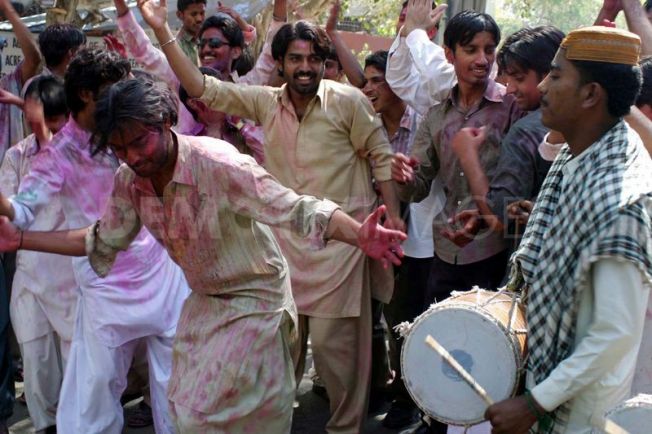
Holi celebrations in Sindh
   Unlike other assets this one is something that the right-wing establishment religiously despises and reckons as Sindh’s greatest sin and calls its inhabitants infidels and Indian agents.
   Sindh has seen little calm and rare self-rule on its soil since time immemorial, but it has been resilient enough so far to protect its most enviable treasure trove – something widely defined as secularism, the art of peaceful co-existence.
   Unlike the most of Pakistan, Sindh is still largely a pluralistic, secular and liberal society. People here too kill others on trivial reasons but at least politically aware Sindhis are not yet convinced to kill each other on religious grounds.
   That tradition goes on; but will it continue hopping like it did in the past centuries? There are serious doubts and concerns as well-laid grand plans are there to create smaller Taliban havens in parts of this land of Sufis – if not possible to fully convert it.
   The planners – well entrenched in the country’s ruling machine and their spare parts in apparently non-state junk – have particularly targeted Sindh’s upper districts, infested with tribal customs largely forced by the migrants from neighbouring provinces, the victims of blatant corruption and negligence by the parties they vote for and abject poverty which is increasingly reaching the tipping point.
   Past events show a disturbing increase in the migration of Sindh’s Hindus to India and elsewhere because of their systematic kidnapping for ransom and abductions and forced conversions of their girls by influential mullahs and feudal lords who blatantly preside over hordes of gangs of robbers in the region.
   Rights activists say hundreds of cases of kidnappings and forced conversions of Hindus and their girls have been committed in the past four years in the northern districts of Sindh, most of which have gone unreported and attracted little attention from the so-called national media, which itself boasted to be centre-right and custodian of the country’s ambiguous ideological borders.
   The events have forced Hindus to migrate in flocks from their soil, a further dent in Sindh’s pluralistic society, which had already suffered a great deal because of migration of its entire middle class – happened to be Hindus – to India in 1947 after the partition of the Subcontinent.
   The dilemma of Sindhi Hindus is that they are often ignored by the world in the times of distress. Pakistani Christians suffer religious indiscrimination and persecution as well, but fortunately the Mighty West follows the same faith and often raises voice for their rights. Our Hindus are already labeled by the patriots in the establishment and media as the Indian agents, thus find no brotherly support from anywhere except for sporadic faint voices from rights organisations and individuals having little influence in bigger arena to change their fate.
   The killing of three Hindu men in the town of Chak in Shikarpur district is considered as the worst incident in decades. Media reports splash several contradictory facts, ranging from personal enmity to the possibility of a victim’s affair with a girl of an influential tribe, but the fact remains that it is bound to accelerate Hindus’ migration. The fact is that this migration will further erode Sindh’s claim to be the country’s only hope for minorities; the land which has always soft spot for minority faiths.
   Whatever the reasons are claimed to have caused the tragedy; the ultimate beneficiaries will remain right-wing mullahs and feudal hypocrites – in terms of their influence and the booty they would ultimately own and share as they did during the mass migration of Hindus 64 years ago.
   These killings should be taken in line with several attacks on NATO trucks in the same district – Shikarpur – as was a suicide blast on Ashura at a Shiite mosque there last year, which fortunately killed just the attacker.
   Being optimistic helps lessening the intensity but pain remains until it is fully cured. The reaction against the Shikarpur killings shows a distinct majority still sides with Sindh’s pluralistic history with intentions to safeguard it. Several demonstrations in scores of towns against the killings are because people don’t want the land to be deprived of its habit to remain peaceful.
   But fear still remains inward as being liberal is something that deep state has little desire to let it go. Pakistan is the land where designs often mirror opposite to the desire of majority; where a tiny minority decides about the national interests and everyone has to follow the suit to remain a patriot – thus alive!

Wednesday, September 5, 2012

Karachi musical makes song and dance of gang wars

by Hasan Mansoor
A hit musical about gangland violence in Pakistan’s largest metropolis is bidding to revive Karachi’s once-rich stage culture while shedding light on its grim addiction to violence.
Fierce sectarian and ethnic conflicts have been responsible for the deaths of more than 1,000 people this year alone and are an all-too-familiar tale to Karachi’s 18 million residents.
But the gritty realism portrayed in “Karachi — The Musical” has nevertheless provoked a huge response, playing to large audiences since it began in October for a month-long run due to finish on November 13.
It tells the story of a rookie boxer from the eastern city of Multan who comes to train at a boxing club in Karachi’s notorious Lyari neighbourhood — better known for its mafias than its sporting talent.
The ambitions of the protagonist, Saif Salaam, spark tensions between his coach and Daud Islam, a mafia don who controls the local gambling, drugs and prostitution rings and wants to thwart the boxer’s success.
With many twists and turns in the story set to a dozen songs, Daud attempts to kill Salaam, just as he had murdered another rising star 20 years earlier.
Mirroring grim realities on Karachi’s streets, the mafioso Daud is only stopped from killing the boy thanks to the intervention of another bad man — a more powerful don whose influence reaches higher into the corridors of power.
“It depicts the situation which we are facing nowadays,” said one theatre-goer, Aleem Akhtar.
“We are infested with mafias and gangs of killers and every mafia is well protected, so we can survive only with the blessings of some good bad men.”
The director of the first original musical to grace the city said that the show represented a defence against the very harshness it was based on.
“Today, art needs more support than ever in Pakistan because it is not only a reflection of the times we live in, but also of a brighter future we can create,” said Nida Butt.
“Theatre is not for the faint-hearted — it’s a labour of love, long hours and hard work that often results in more (money) spent than earned,” she added.
The once-thriving stage scene in Karachi, which was known for its opera before the partition of British India to create Pakistan in 1947, was lost largely due to the growing Islamisation of the country, say artists.
They particularly point the finger at military dictator General Zia-ul Haq, blaming him for worsening the gun and drug culture, encouraging sectarian and ethnic parties and crushing liberal forces during his 1977-1988 rule.
Art began losing its way under Zia’s predecessor Ayub Khan, they say, but it crumbled as culture became an early casualty of Zia’s regime, which nurtured religious fanaticism.
Syed Ahmed Shah, who heads the Karachi Arts Council and whose theatre is staging the production, says his organisation is the only one with a dedicated auditorium for plays and theatrical performances in Pakistan’s biggest city.
“Our resolve is to fully revive the city’s old cultural status so that it is here to stay,” he said.
“Particularly in a situation where fear and anxiety are the order of the day. Culture is the only remedy to rely on,” he said.
Hamza Jafri, who composed the original scores, said that “Karachi – The Musical” drew on the various strands of the city’s musical culture — a mix of rock opera, indigenous beats and big band jazz.
“The music is edgy, contemporary and completely inspired by our research into Lyari and the boxing gangs there. The songs talk about us, about Karachi and our lives in this city today,” he said.
But those living among the conditions depicted on stage complain they cannot see it because they are priced out of the market, with tickets costing 1,500 rupees (18 dollars) each — five times as much as a first-class cinema seat.
“I would love to watch such plays but it is getting too tough to enjoy theatre and cinema nowadays,” said Maula Bakhsh, 35, a fruit vendor in Lyari.
“We hardly feed our families because of price hikes. How can we spare money to spend on that luxury?” said Bakhsh — adding that he had to abandon his own boxing career to support his family.
AFP

Saturday, September 1, 2012

NATO attacks fuel American flag business in Pakistan

by Hasan Mansoor
   In Pakistan a row about American attack on the country’s vague and much-trumpeted sovereighnty means booming demand for replica American, Indian and Israeli flags to go up in flames at protest rallies.
   That means one thing for 31-year-old Mamoon ur Rasheed — business — and he is working long into the night to churn out the paraphernalia beloved of Islamic activists taking to the streets.
   “I have nothing to do with any political party, but it is really enjoyable when you see your work on TV screens,” a laughing Rasheed said.
   “I’m busy every day making banners and placards for different religious and political parties, but work gets a boost — especially when international controversy concerning Muslims breaks out,” he said.
   Two years ago, when a Facebook user decided to organise an “Everyone Draw Mohammed Day” competition to promote “freedom of expression”, it sparked a major backlash among Islamic activists in the South Asian country of 170 million.
   Islam strictly prohibits the depiction of any prophet as blasphemous and the row sparked comparison with protests across the Muslim world over the publication of satirical cartoons of Mohammed in European newspapers in 2006.
   Several hundreds Pakistanis have taken to the streets at the behest of right-wing religious groups, who turn to Rasheed when they need flags to burn and banners to write.
   “Generally, we receive orders for banners for a couple of demonstrations a day, but due to the NATO attacks on Pakistani soldiers and blasphemous drawings issue, which causes spark time to time, the number of orders for flags and banners increases manifold a day,” said Rasheed.
   “Flags are made for burning. They symbolise what our clients want to express and we are paid for it, so I’m happy to see our work go up in flames.”
   Rasheed owns a workshop where he employs four craftsmen to paint flags and write calligraphy, and a small printing press.
   “We have received continuous orders for American and Israeli flags. Normally we paint them but when demand surges into the hundreds we print these flags to get them to our clients in time,” he said.
In the wake of the controversy caused by the NATO attack inside Pakistan, have blocked supplies for NATO forces to Afghanistan through its territory and mulls over to expel Americans from its Shamsi airbase.
   Although none of the protests has mobilised the masses, sporadic demonstrators have continued to vent anger in Karachi and other cities.
   Rasheed runs his business on times of stress. Different periods mean demand for the flags of India — Pakistan’s deepest rival with whom the country has fought three wars — Norway and Sweden, and former colonial ruler Britain.
   Five years ago, widespread protests broke out in the conservative Muslim nation over satirical cartoons of Mohammed that were published by a Danish newspaper and then reprinted in other European countries.
   Then in 2008, thousands of Pakistani Islamists rallied against an anti-Koran film made by a far-right Dutch lawmaker. Another focal point for anger has been Swedish artist Lars Vilks, who etched a blasphemous caricature.
   Whenever elections approach or protests start, wholesalers stock huge quantities of cheap cloth and reap handsome rewards.
   “We are getting bigger orders from scores of painters and printers nowadays,” cloth merchant Mohammad Siddique said.
   “Pakistan is the country of protests and for this Karachi is undoubtedly its capital and our business gets a boost in such circumstances,” Siddique said.
   Waqar Ahmed, owner of a printing press in Karachi’s southern neighbourhood Pakistan Chowk, says orders are flooding in for posters, pamphlets and placards, temporarily overtaking his main business in books and wedding cards.
   “I get orders for pamphlets and posters in the event of controversies or elections,” Waqar says.
   “I have got some orders to print flags of United States – in hundreds – during the ongoing rallies. We have also sold many American and Swedish flags during the protests against Facebook,” Ahmed said.

Thursday, August 30, 2012

They dance in Sindh to capture Punjab!

By Hasan Mansoor

(Written in November 2011)
Shah Mehmood Qureshi can conveniently be regarded as the greatest of all hypocrites and power-hungry individuals who are jumping on Imran Khan’s bandwagon.
   His hypocrisy is evident from the religious allegories he had associated in his speech in Ghotki, where he finally ended his role as the fence-sitter and joined Imran’s Tehrik-e-Insaaf.
   A show in Ghotki can never be applied on the whole Sindh. Ghotki is the smallest of Sindh’s border districts, taken hostage by the influential tribes, whose chiefs are as opportunist and corrupt as elsewhere. They boast on honour killing of women and harbour and nurture criminals to keep people in distress and manipulate election results to their own advantage.
   Local people confirm that majority of the participants of Qureshi’s rally were unknown to them. They had been transported in trucks and lorries from the bordering southern Punjab’s towns.
   “Some of the participants were provided by the influential Mahers of the district, while the rest might form the total supporters of Qureshi who revere him because of his being a gaddi-nasheen of a shrine,” a local political observer told me.
   This rally cannot be regarded as something, which reflects a change in the mood of Sindhis. Both Qureshi and Imran Khan stick to their guns against the government. They spoke of the so-called corrupt practices being committed by Zardari’s government, bragged about their being the clean entities and hit hard against the Sharifs.
   Actually, they discussed Punjab’s politics in Sindh. Both the PTI leaders have stakes in Punjab and they see little prospects in Sindh, the question remains why they chose a place elsewhere to fight for Punjab? Qureshi wanted to show his popularity on trans-provincial scale while Imran was keen to see his bag gets fully stuffed.
   But, none of them spoke about the worst miseries of Sindh caused by the floods the second year running. They talked about the ambiguous NRO controversy, war on terror, United States, Pakistan’s vague sovereignty and Afghanistan and Iraq but deemed it inappropriate to talk on the real problems of Sindh.
   Qureshi, on the occasion, went on to the religious allegories in his speech, which hardly impress Sindhis’ secular minds. Spectacular of all was when he put himself in the shoes of Central Asian warrior Mehmood Ghaznavi by saying he would attack on Somnaath’s temple. He said his rally’s day coincided with the advent of the holy Islamic month of Muharram which, according to him, was a good omen to the country’s secured fate.
   Qureshi received an immediate bashing from across the southern province’s intelligentsia who condemn him for his desire to attack a temple no matter that was a clichéd symbolic notion.
   “Sindhis have always respected the worship places of all faiths and cannot tolerate or appreciate such clichés, which have been created and safeguarded by the powerful establishment,” said one of several statements published in the Sindhi newspapers.
   Sindhis have the history not to support the religious bigots. They still keep their religion and routine life separate despite the deep state’s repeated attempts to corrupt it through the kidnapping and persecution of minority Hindus and their girls’ forced conversion by the mullahs whose sanctuaries are being expanded systematically.
   Imran might take time to keep his finger on the pulse of Sindh, but why Qureshi went so aggressive in his panegyric to his brand-new leader, though he is well accustomed to the Sindhi environs. He is in the process of changing his posture that suits his new party’s right-wing propensities. He wants the people to forget his popular images with Secretary Hillary Clinton showing him sharing broad smiles with his then counterpart whom now he strategically despises.
   One should admire Zardari for his prudent decision in 2008 not to select Qureshi as party’s nominee for the country’s next prime minister. Zardari must have foreseen Qureshi’s hypocoristic leanings that many critics did not.
   But, haven’t Imran started sipping hypocrisy when he gives a clean chit as the foreign minister to Qureshi in Ghotki, an individual whom he had criticised him in his book “Pakistan A Personal History”.
   He writes: “These loans, along with US and European aid money, are like bribes to the Pakistani political elite to keep fighting America’s war for them. This was painfully evident when in October 2010 Pakistan’s foreign minister Shah Mehmood Qureshi told the European parliament: ‘If you want to help us fight extremism and terrorism, one way of doing that is making Pakistan economically stable.’ Pakistan’s ruling elite threatens the West with fears about Islamic militancy to extract more money out of them.”
   We should still admire Imran Khan, after all, he is the saviour we the poor souls have been waiting for the salvation!
Ends

Illegal lives: Karachi’s two million immigrants face a government crackdown

by Hasan Mansoor
My 2002 report for Himal South Asian Magazine
When Pakistan launched its National Alien Registration Authority (NARA) in January 2002 to address the perceived problem of illegal immigration, an estimated 3.3 million non-citizens were residing unlawfully in the country, close to two million in the southern city of Karachi alone. NARA received a mandate of three years to document illegal residents in Pakistan, specifically those in Karachi, and to issue work permits to non-citizens “who will get themselves registered”. But, perhaps not surprisingly, 18 months into its mission and halfway to its deadline of December 2004, NARA has registered only 35,000 people, just one percent of the estimated total.
The reasons for NARA’s poor performance to date are numerous, though many relate to difficulties inherent in differentiating ‘real’ Pakistanis from non-citizen ‘impostors’. Immigrants and their children have blended into Karachi’s bustling urban life, and many have secured government-issued National Identity Cards (NICs), often with the help of other non-citizens elected (illegally) to local administrative bodies. More broadly, they have created their own patronage networks and ensconced themselves into Karachi’s existing ones, gaining access to jobs, political connections and social services that make them as much residents of the city as any native-born citizen.
Owing to the scale and diversity of the immigrant population, estimates of its size and composition remain rough. In Karachi, the largest segment – about 1.3 million – hails from Bangladesh, while totals from Africa, Burma and India reach into the hundreds of thousands. Most Bangladeshi migrants travel overland to Pakistan via India, where they are sometimes able to make arrangements in advance for work in Karachi, where supposedly pays are higher than anywhere else in South Asia. Karachi is also home to 80,000 Afghans, who are counted as refugees rather than as aliens on the assumption that they will return to their native country once conditions improve.
In a sprawling city of 12 million-plus people, Karachi’s non-citizen residents represent about 15 percent of the total population, and because many of them have secured voting rights, they constitute a significant electoral block. A report prepared by NARA’s Karachi office states that at least 80 unnaturalised immigrants have been elected to a cluster of 20 union councils in the city, six of which are led by non-citizens, though local government officials put the number of elected immigrants at closer to 130. Another three dozen such candidates are believed to have gained office in
the interior of Sindh. And while about half of the non-citizen population in Karachi is concentrated in the city’s western district, it has spread effectively throughout the entire metropolis, often in small squatter settlements, making identification of ‘illegals’ all the more difficult.
On the whole, NARA officials’ efforts to register immigrants appear thwarted at nearly every turn, sometimes violently. Non-citizen residents in the Karachi localities of Machchar colony, Ibrahim Hyderi and Mauripur recently turned back visiting NARA officials with force, and NARA’s efforts outside of the metropolis enjoy no greater success. Attempts to register international migrants in the southern cities of Nooriabad and Thatta, in Sindh, and Hub, in Balochistan, have failed, casualties of patronage networks and organised resistance to the campaign. “The problem is that aliens have got powers to resist and help their other fellows to become Pakistanis”, an officer explains, noting that he and his colleagues are ill-equipped to overcome such tactics. NARA also suffers from more banal organisational woes, in particular cash shortage that prevents it from acquiring a fleet of vehicles or expanding its staff beyond its present four-dozen employees.
Patronage politics
Owing to its size and uncertain legal status, Karachi’s non-citizen community has enmeshed itself in the patronage networks of politicians and political parties, trading votes for political protection. The millions of non-citizen residents living in Karachi have proven to be a valuable vote bank for political parties, particularly for those with weak roots in the metropolis.
Mazhar Shaikh, an additional director general of NARA, expresses dismay at the nearly impossible task of registering non-citizen residents, the fault for which he says rests in large measure with their political connections. “A number of them have become elected nazims [mayors] and councillors, who stop their community members from getting registered”. He says that once elected, these officials push through NIC applications for other non-citizens to help them evade detection by NARA. Shaikh says that he has notified the National Database Registration Authority (NADRA), which issues NICs, about the difficulties NARA faces with identity card evasion tactics. A solution is yet to be found. “A joint line of action is under consideration”, says Shaikh, adding that the powers of some councillors to attest NIC applications may be suspended while discreet investigations are carried out. For its part, NADRA says that it is reviewing candidate filings in an attempt to root out politicians who lack citizenship.
Ejaz Shafi, a former MP who lost an election last year standing from Karachi as a candidate of the Pakistan Muslim League (Nawaz), has championed the cause of Bangladeshi migrants for more than a decade. In return he has received support from the thousands of immigrants for whom he has helped secure NICs and space on voter rolls. Though he lost last year’s race to a candidate of the religious parties alliance, Muttahida Majlis-e-Amal, Shafi received strong support from the estimated 20,000 Bangla-speakers in his constituency. As a strong supporter of the community, he refuses to use to the term ‘alien’ to designate persons of Bangladeshi origin living in Pakistan. “They are Pakistanis in all respects, by all conditions universally accepted for citizenship”, he says.
Other parties, such as cricketer-turned-politician Imran Khan’s Pakistan Tehrik-e-Insaf, Allama Tahir-ul-Qadri’s Pakistan Awami Tehrik, and former president Farooq Leghari’s Millat Party, have made concerted attempts to
cultivate Bangla speaking voters. Many political aspirants seek support from residents of Machchar colony, a squatter settlement inhabited by 50,000 Bangla-speakers on land owned by the Karachi Port Trust (KPT). The KPT has made several attempts to evict residents, but each time influential politicians come to the aid of the slum-dwellers. “When I was an MP from this area, I did not allow the KPT to evacuate them”, Shafi says, adding that he suggested instead that the port reclaim land from the upscale Clifton locality.
However, not all political parties cultivate the foreign-born vote – indeed, some doubt the calculations on immigrant electoral strength, and others have tapped into local resentment of the large Bengali community to mobilise support. A leader of the Muttahida Qaumi Movement (MQM), an offshoot of a partition-era north Indian organisation of Urdu-speakers, argues that patronage networks have not worked to the advantage of immigrants, as despite being included on voter rolls, the government “cautiously sliced them out of Karachi’s population” when it came to distributing resources.
However, this has not stopped parties from pandering to non-citizens at election time, he says, and he accuses several of illegally registering non-citizens as voters. “Even rightwing Jamaat-i-Islami activists have put many Afghan voters on rolls in the city’s central district to harm the MQM”, he says. Another political mobiliser, this one from the Pakistan People’s Party (PPP), perhaps the most powerful political force in Sindh, says that his group does not register non-citizens, as doing so would harm the interests of Pakistanis.
Controversy surrounding immigrants extends to the job market, where local resentment is perhaps more acute than in the field of politics. For non-citizens who find work, it is typically as domestic servants, as low-wage employees in the garment or fishing industries, or in jobs such as sugarcane pressing. Because they are usually willing to work for less pay
than native-born Pakistanis, they attract the ire of locals as well as muffled praise from employers, who tend to be exploitative.
Many ethnic and nationalist political organisations, as well as labor groups, regularly carry out campaigns against immigrant employment on the ground that recent arrivals damage the economic prospects of the native-born. Along with the MQM, the Jeay Sindh Qaumi Mahaz (JSQM) opposes the growing presence of non-citizen workers in Sindh’s economy. The parties’ election manifestoes accuse immigrants of depressing local wages, and promise improved job prospects for native-born (Urdu-speaking) Pakistanis once they are able to prevent migrants from participating in the economy. “These aliens are a burden on Sindh”, JSQM chairman Bashir Qureshi says, adding that it is the government’s responsibility to solve the problem.
Searching for ‘solutions’
The MQM’s Kunwar Khalid Younus argues that the government should settle the illegal immigration problem once and for all. “What we need is just the political will to do that”, he says. As far back as 1993, intelligence agencies considered competing proposals to ‘solve’ the problem, one being a massive repatriation scheme, primarily of Bangladeshis. This was deemed impractical, however, as for its part, Pakistan refuses to take in the ‘Biharis’ – the nearly 300,000 Urdu-speakers who have languished in 66 Bangladeshi urban refugee camps since the early 1970s. In any event, the ‘exporting’ countries are unlikely to cooperate with Islamabad’s repatriation schemes; in August 1996, Dhaka refused to accept 70 Bangladeshis deported from Karachi because they carried Pakistani NICs and passports.
What ‘solutions’, if any, can be found to the non-citizen resident question is a matter of pressing concern in Islamabad. In addition to launching NARA and debating the repatriation scheme, Islamabad has investigated other methods of regulating immigrants’ existence and bringing them within the scope of the law. There is a process by which non-citizens can secure legal residence and work status, but its costs are prohibitively expensive for most immigrants: until recently, PKR 10,000 (USD 180) and PKR 1000, respectively, for registration and work permit cards. Even after reductions to PKR 2500 and PKR 500, most non-citizens lack the finances to take advantage of these options, particularly when becoming ‘legal’ is not viewed as a pressing concern. “We often spend much less than this to get [forged] Pakistani documents”, a Bangladeshi migrant living in Federal B Area explains. For citizens of Bangladesh and Burma, there is also the option of formally applying for Pakistani citizenship under Rule 13/A of the Citizenship Act, though Islamabad has approved less than 1000 of such naturalisation applications till now.
Another idea is to provide migrants with transit back to their countries of origin on non-citizen Pakistani passports. A committee convened by the federal government, which included two Bangla speakers as ex-officio members, recommended the issuing of so-called ‘white passports’ to migrants from Bangladesh and Burma so that they may visit their countries of origin and migrate back, if so inclined. But to receive a white passport, migrants would first have to register with NARA and fill out Form E-I under the Citizenship Act, a step most non-citizen residents are hesitant to take. However, this plan possesses the advantage of offering an avenue for migrants to return to their birth countries, if they so desire, and some NGOs have expressed interest in facilitating such a process and providing financial support to
returnees.
While many Bangla speakers in Pakistan arrived relatively recently, there is also the challenge of adjudicating the citizenship claims of Bengalis whose residence dates to the 24 years between the 1947 partition and Bangladeshi
independence. The same federal committee that issued the recommendation about white passports also proposed granting Pakistani citizenship to Bengalis – not Bangladeshis – living in (West) Pakistan before the Bengali nationalist capture of Dhaka on 16 December 1971. After Bangladesh’s war of independence, fewer than 25,000 Bengalis opted to remain in Pakistan, according to NARA director general Shaikh, while most of the rest migrated to the former eastern wing. A 1978 amendment to the Citizenship Act nullified the Pakistani citizenship of those domiciled in erstwhile East
Pakistan. Bengalis remaining in Pakistan were required to submit a Form E-I to the home department of their province of residence and apply for citizenship, although according to the Sindh home department, no Bengalis submitted such forms in that province after the war. Many of these people have led a precarious legal existence for the past three decades.
The government committee also held meetings with Bengali community representatives and, in response to concerns that they lack documentary proof of residence, proposed that local police officials be empowered to recommend the granting of citizenship after verification. Critics, however, say that this proposal would only lead to massive corruption among police officers. Another widely shared concern among non-citizen residents is the suspicion that the entire government registration process is merely a plot to launch deportation proceedings once particulars are known to authorities. Interior ministry officials dismiss this claim, and note that none of the 35,000 migrants registered to date have been deported. “On the contrary, we are trying to resolve their civic and social problems, including extending
them educational, health and other facilities”, says one official. He also discloses that the government committee has been asked to review other countries’ immigration and citizenship policies in order to suggest improvements in Pakistan’s system.
13 kg of bad publicity
Debates about the role of ethnic-minority non-citizens in Pakistani society and politics, and the proposed methods of dealing with the concerns of and about them, are also coloured by anxieties about the supposedly dangerous and illegal practices of some elements of the immigrant population. Statements from Pakistan’s interior ministry indicate that there is increased official concern about non-citizen residents’ involvement with religious schools accused of fueling sectarian hatred, and with criminal activities ranging from burglaries and murder to international drug trafficking. A recent interior ministry socio-economic survey showed that non-citizens are concentrated in 22 localities of Karachi, many in ‘sensitive’ places near sea, oil and power installations and army cantonments, prompting the police to recommend mass evictions in these areas.
Concerns about links to religious violence are heightened given Karachi’s experience with sectarian violence. NARA research shows that the migrant community is making concentrated use of 29 government schools and nine hospitals, and operates 44 madrasas, about five percent of the city’s 869 Islamic schools. Regarding those schools, authorities say that, despite it being a small proportion of the city’s total, they are nevertheless worried about an influx of students into these largely unregulated institutions.
Today, most foreign students in the madrasas come from Afghan, Burmese or Bangladeshi backgrounds, although until two years ago there were also large numbers of African and Southeast Asian students. With the opening of the US military campaign in Afghanistan in October 2001, however, overseas enrolment in Karachi’s madrasas plummeted, and now foreign-born students represent only four percent of the 264,169 madrasa student total for Sindh, 85 percent of which is concentrated in Karachi, according to a recent police report.
The already precarious position of foreign-born residents in Karachi vis-à-vis the police is further complicated by military and law enforcement efforts associated with the US ‘war on terror’. The US Federal Bureau of Investigation (FBI), with the help of Pakistani authorities, is closely monitoring mobile phone conversations in Pakistan, and has arrested hundreds of foreigners suspected of links to Al Qaeda and other militant outfits. The FBI conducts operations in the country with the blessings and assistance of Pakistani officials, who have toed the US line since September 2001. Among the several thousand people arrested to date in these operations, officials say that about 700 are non-Pakistanis, mostly Afghans and Arabs, but there are also some Africans, Bangladeshis and Burmese.
The police also highlight migrants’ participation in local crime, in particular their connections to robbery, kidnapping, narcotics smuggling, human trafficking and murder. “We have evidence of their involvement in serious offences, and we have recommended that the government take the issue seriously”, the inspector general of Sindh police, Syed Kamal Shah, alleges. According to a police report, non-citizens are implicated in a widespread network of trafficking girls from Bangladesh and Pakistan to the United Arab Emirates. Police also suspect that immigrants have worked as hired killers
in Karachi’s recent spate of high-profile murders.
These concerns came to the surface in late spring with the high-profile arrests of three Bengali drug smugglers. On 21 May, Bangladeshi airport authorities arrested three women traveling on Pakistani passports for possession of 13 kilograms of heroin valued at USD 2.25 million, one of the largest drug hauls ever in Dhaka. Pakistani authorities had tipped off their Bangladeshi counterparts, who discovered the contraband in paste tubes hidden in the women’s luggage. A preliminary investigation into the case by Pakistani officials uncovered that the traffickers were Karachi-based
Bengalis who had bribed officials to receive documents attesting Pakistani citizenship. According to Pakistani authorities, travel on forged or falsely issued Pakistani documents is quite common, though it is ‘real’ Pakistani citizens who receive a bad reputation for such practices. Several Afghans have also been caught committing similar crimes, though Bengalis are believed to be more frequent offenders.
The Dhaka drug bust, extensively covered in the Pakistani media, led to hand wringing and accusation-leveling in Karachi. An official of the PPP cites the heroin arrests as evidence of the negative consequences of migrants participating in the political process. Others point to the implications of the incident for the entire bureaucracy. A thorough investigation into the Dhaka case, if and when it occurs, could raise troubling questions about the efficiency and integrity of NARA, which issues NICs and prepares voting registers, as well as other departments in the internal affairs ministry, such as the passport-issuing authority. Precisely how long corrupt practices have been occurring, and the extent to which bribery permeates the system, are difficult to assess, although anecdotal evidence paints a worrying
picture.
The heroin arrests prompted great interest at least in part because they touched on another widely held concern about non-citizen residents – their alleged widespread drug use. According to a United Nations Development Programme report, drug abuse among immigrants in Pakistan is rampant, and because of needle-sharing authorities suspect that HIV is on the rise in the community. Even so, such drug use is both a cause of concern and a symptom of their perilous condition, as many take up the expensive indulgence to alleviate the psychological stress and general frustration of leading a quasi-legal existence.
Yet, whether it concerns illegal activities or dangerous habits, official and popular scrutiny of Bangla speakers is greater than that of native-born, Urdu-speaking Pakistanis, and there are concerns that allegations of criminal activity are being exaggerated to malign the community. An October 2001 report in the Dawn of Karachi on immigrants in Pakistan states, quoting police sources, that “the over-all involvement of Bengalis in crime is negligible”, and that “contrary to a general perception”, at most 200 Bengalis are involved in crime in Karachi. This appears to contradict some of NARA’s positions, such as the claim that non-citizen residents are “adding to the crime rate”. Given that persons who lack clear legal status will likely seek to avoid activities provoking the interest of law enforcement officials, there appear to be grounds for doubting some of NARA’ s more sweeping charges of mass criminality in the migrant community.

Thursday, December 22, 2011

Calls for army grow as Karachi week toll hits 101


   by Hasan Mansoor   
Pakistani politicians, industrialists and citizens stepped up calls Tuesday for the army to intervene to quell violence destabilising Karachi, where more than 100 have been killed in a week.    "We demand the armed forces take over the city, restore law and order and ensure safety to innocent people's lives," Khalid Tawab, vice president of the Federation of Pakistan Chambers of Commerce and Industry (FPCCI), told AFP.    "Business activity has been disrupted because of incessant killing. People don't want to go to market because of risks to life," he said.    Ethnic and criminal violence blamed on gangs has killed 101 people in the last week, the latest bout in the worst criminal and ethnic violence to hit Pakistan's largest city and financial capital for 16 years.    "At least nine people were killed since Monday evening, so far 101 people have been killed since Wednesday morning," a senior security official told AFP on condition of anonymity because he was not authorised to speak to media.    Security officials said they had found the bodies of victims who had been kidnapped and tortured, stuffed into sacks and thrown on the streets with notes warning of more violence.    A government official working in the health department confirmed the casualties.    The violence has been linked to ethnic tensions between the Mohajirs, the Urdu-speaking majority represented by the Muttahida Qaumi Movement (MQM), and Pashtun migrants affiliated to the Awami National Party (ANP).    On Tuesday, markets were closed, streets deserted and attendance at offices thin after the MQM called for a "day of mourning" against the killings.    Prime Minister Yousuf Raza Gilani on Monday flew to Karachi and asked the provincial government to restore peace as quickly as possible.    Sharjeel Memon, Sindh provincial information minister, said a "surgical operation" was planned to end the violence.    The main ruling Pakistan People's Party (PPP), which was elected in 2008 after nine years of military rule, insists that civilian authorities are capable of controlling the situation.    But members of other political parties are increasingly calling for army intervention, a sensitive issue in a country that has been ruled for more than half its existence by the military.    "We want to see law and order in Karachi improve. Anyone, including the army, who can get results and improve the situation should take control," Wasay Jaleel, a spokesman for MQM, told AFP.    "We demand the army across the board to restore peace here," ANP's provincial chief Shahi Syed told AFP on Tuesday.    People on the streets also expressed dissatisfaction with the ability of the police and the paramilitaries, technically answerable to the interior ministry, to control the situation.    "The armed forces should be deployed in Karachi, because police and paramilitaries have failed to save our lives," said Khalid Ali, 45, a shopkeeper in the main downtown market area that has seen some violence.    "We feel no enthusiasm for the coming Eid (religious festival). Please, soldiers take the city in their hands and return smiles to our children," Noshaba Hameed, 37, a schoolteacher, told AFP by telephone from the east.    Independent analysts said army's deployment would affect Pakistan's war on Taliban in its northwest and aggravate the situation further.    "Army is already engaged in the war on militants in the northwest and its involvement in Karachi will weaken the war," Tauseef Ahmed Khan, a columnist, who teaches mass media in Urdu University, told AFP.    "Only the police could restore law. The government should give a free hand to operate. That could make wonders," he said.

Brutality, impunity for Pakistan's paramilitary

by Hasan Mansoor    
The killing of an unarmed youth in a public park by uniformed officers in Karachi highlights the reputation for brutality of Pakistani security forces in a violent city where murders are commonplace.    Answerable to the interior ministry, more than 12,000 paramilitary troops patrol the financial capital and its surroundings to combat ethnic, political and Islamist violence. But the violence has only got worse.    By any measure, the killing of 19-year-old Sarfaraz Shah, falsely accused by a civilian of committing robbery, was horrific, all the more so for being captured live on camera and broadcast around the clock on national television.    In the footage, a clean-shaven man pleads for his life before being shot twice in the hand and thigh. As his blood poured out of his wounds, the soldiers appear to do nothing but watch as Shah falls unconscious.    The shooter and his five uniformed comrades and a civilian were arrested and tried in an anti-terrorism court, which sentenced him to death and awarded life sentence to the rest.    The decision has been challenged in a superior court.    "This is completely against humanity. What the Rangers did is unacceptable because by this way they can even kill small children in streets and say that they were dacoits," said cab driver Ameer Khan, using an Anglo-Indian colloquialism which refers to members of armed gangs.    In a rare move, Pakistan has since removed from their jobs the heads of the police and Rangers in Sindh province, of which Karachi is the capital.     Authorities are also investigating the killings of five unarmed Chechens, one of them a pregnant woman, by security forces in the city of Quetta.    Accusations of several hundred extrajudicial killings dog the military in the northwestern district of Swat, where troops fought to put down a Taliban insurgency in towns and villages in 2009.    Human rights activists say units such as the Rangers, originally established for combat and border duty, are neither equipped nor trained for civilian areas.    "The paramilitaries consider themselves accountable only to the army and that civilians are inferior. Therein lies the problem," said Zohra Yusuf, chairwoman of the independent Human Rights Commission of Pakistan (HRCP).    "As their stay in the city gets longer, the situation worsens," she added.    "Paramilitaries are appointed to cities having had just basic combat training. They should be sensitised with specialised human rights courses to help them adjust."    According to the HRCP, 800 people have been killed in targeted shootings in Karachi so far this year, compared to 748 last year. A fresh bout of assassinations blamed on political tensions has left 70 people dead in the last three days.    Islamist militant violence is also on the rise in Karachi, a chaotic city of 16 million people whose port is a vital hub for NATO supplies bound for Afghanistan.    Shrines have been attacked, a police headquarters bombed. In the last two months, a Saudi diplomat was shot dead, the Saudi consulate targeted by grenades and the naval base held up.    It took the navy 17 hours to fight off a handful of militants who killed 10 security officials and destroyed two US-made aircraft.    Yet in the vast city, a magnet for economic migrants where the government says the population increases by 500,000 each year, 28,000 police are simply incapable of enforcing law and order.    Therefore officials say the Rangers are needed to help patrol the streets, safeguard government buildings and diplomatic missions, and to be on call in the event of riots, bombings or shootings.    "The paramilitary forces were meant to assist the civilian administration for a shorter and specific time, but here they have been engaged for two decades," said provincial government adviser Kaisar Bengali.    According to government figures, Pakistan has 350,000 policemen -- one for every 500 people -- with significant numbers diverted to secure government officials, politicians and top civil servants.    "Our province doesn't have enough money to spend on capacity-building the police and we have no such programme," said Bengali.    Sharfuddin Memon, an expert on policing in the provincial government, said there was a serious trust deficit between the law enforcement agencies and the people, and called for accountability through public safety commissions.    In the working-class, government loyalist stronghold of Lyari, Pakistan People's Party (PPP) workers have staged demonstrations accusing the Rangers of killing two locals in a shooting last month.    But government officials insist the park killing was an isolated incident by rogue officers that does not reflect an institutionalised brutality.    "We shouldn't blame the institution," Sharjeel Memon, Sindh's information minister, said.    "The Rangers have made a spectacular contribution to maintaining law and order," he said.

65 killed in Karachi violence


by Hasan Mansoor   
Ethnic and criminal violence blamed on gangs has killed 65 people in Pakistan's financial capital of Karachi, with police the latest victims shot dead in a brazen ambush, officials said Saturday.    The government has been left struggling for solutions to the worst wave of unrest to sweep the city in 16 years as extra deployments of police and paramilitary officers appear unable to stem the troubles.    Spiralling unrest is a major source of concern in Pakistan's biggest city, which is used by NATO to ship the bulk of its supplies to troops fighting in Afghanistan and which accounts for around a fifth of the country's GDP.    The violence has been linked to ethnic tensions between the Mohajirs, the Urdu-speaking majority represented by the Muttahida Qaumi Movement (MQM), and Pashtun migrants affiliated to the Awami National Party (ANP).    Gunmen ambushed police late on Friday, sparking gunbattles in which four officers were killed and more than 30 others wounded, officials said, bringing the death toll to 65 since Wednesday morning.    The police commandos, dressed in plain clothes, were targeted in the eastern neighbourhood of Korangi, which had previously been immune from the troubles.    "These policemen were in a van going on a raid on a tip-off when they were intercepted by armed men who started firing, injuring many policemen," senior police official Shaukat Hussain told AFP.    "The police returned fire and at least one attacker has been killed."    Television footage showed injured policemen being carried by their comrades and local residents into ambulances and private vehicles heading to hospital.    "Our hospital has received 32 injured policemen, four of whom are critically injured. They all have gunshot wounds," said Seemin Jamali, spokeswoman for the Jinnah Post Graduate Medical Centre.    Karachi city police chief Saud Mirza told AFP that four policemen were killed.    Speaking after the funerals of the dead policeman on Saturday, provincial police chief Wajid Durrani said two of the attackers who fired at the police van were arrested.    "We have caught two attackers and we are interrogating them about others," Durrani said, adding that 18 people who were kidnapped on Friday had been retrieved by police.    Provincial home minister Manzoor Wasan said he could not give details about which parties or ethnic groups were involved in the violence, but said that "some 100 suspects had been arrested so far".    Witnesses in Korangi said there were pockets of intense gunfire between armed groups with ordinary people too frightened to leave home. Dominated by Urdu speakers, the area also has Pashtun, Baluch and Sindhi populations.    Karachi, currently a city of 18 million inhabitants and the country's economic powerhouse, has seen its population explode since independence in 1947.    Its neighbourhoods have been swollen by a huge influx of migrants from across the country, but particularly the deprived Pashtun northwest, looking for jobs and more recently to escape Taliban and Al-Qaeda-linked violence.    Speaking off the record because they were not authorised to release the information to the media, two security officials confirmed that 65 people had now died in violence in Karachi since Wednesday morning.    The city's worst-affected areas are impoverished and heavily populated neighbourhoods where most of the criminal gangs are believed to be hiding.    Independent economist A.B. Shahid estimated that 20 percent of the city's business was shut down on Thursday with markets closed in southern neighbourhoods to protest against extortion money demanded by criminal gangs.    Underlining the brutality of the violence, one security official said bodies of those kidnapped and killed had been stuffed in sacks before being dumped in various parts of the city.    He said the bullet-riddled bodies of four young men who worked for a mobile phone company had been found in a van with their hands and feet trussed in the impoverished Shershah neighbourhood.    "At least 20 killed on Thursday were kidnapped and tortured by armed gangsters. Their bodies were later stuffed in sacks and thrown away in different areas," the security official told AFP on condition of anonymity.    Notes had been left inside the pockets of clothes worn by some of the victims that read "Want more bodies?", the official said.    The independent Human Rights Commission of Pakistan said 800 people have been killed in Karachi so far this year, compared with 748 in 2010.

Thursday, December 15, 2011

Bomb kills three Pakistani soldiers


by Hasan Mansoor

KARACHI, Dec 9, 2011 (AFP) - Bombers killed three Pakistani soldiers Friday as firefighters battled to control an inferno at a NATO trucking terminal attacked two weeks after Pakistan shut the Afghan border to US supplies.

The roadside bomb exploded alongside a vehicle carrying members of the Rangers paramilitary in Karachi, Pakistan's port city used by the United States to ship the bulk of supplies needed by 140,000 foreign troops in Afghanistan.

The powerful explosion badly damaged the vehicle and wounded four other soldiers in the eastern part of the city after daybreak, officials told AFP.

"Three troops from Pakistan Rangers were killed and four were hurt. It was a remote control bomb," said Sharfuddin Memon, a spokesman for the home ministry in the southern province of Sindh.

Mohammad Salim, an office worker in a nearby government office, said he saw the troops lying on the ground with the vehicle in flames.

"It was a loud explosion. I was going to the office and I rushed to the spot where the rangers were lying on the ground. They were bleeding," he told AFP.

Karachi is Pakistan's largest city, its financial hub and a lifeline for US and NATO troops fighting the Taliban in landlocked Afghanistan.

But the Afghan border crossings have been closed to NATO for 14 days, the longest period since the US-led invasion ousted the Taliban in late 2001.

Pakistan shut its two border crossings in the north and southwest on November 26 in protest after NATO air strikes killed 24 Pakistani soldiers, the deadliest single cross-border attack of the 10-year war in Afghanistan.

The government also ordered US personnel to vacate the Shamsi air base in the southwestern province of Baluchistan, widely reported to have been a hub in the covert CIA drone war against Taliban and Al-Qaeda on Pakistani soil.

Overnight, gunmen destroyed at least 34 trucks in a gun and rocket attack on a NATO trucking terminal in Baluchistan, where police said the fire brigade was still struggling to extinguish the inferno.

"The oil tankers are still on fire. Firefighters have been unable to control it. It was a huge fire," police official Mohammad Majeed told AFP by telephone from the city of Quetta, the capital of Baluchistan.

"We have no final count on how many tankers were torched but you can say dozens were destroyed," Majeed added. Around 44 oil tankers and goods trucks had been parked at the temporary terminal, one of three set up in and around Quetta for stranded vehicles.

No group claimed responsibility for the attack but the Taliban have in the past carried out similar strikes to disrupt supplies.

The bulk of supplies and equipment required by foreign forces in Afghanistan are shipped through Karachi, although US troops have increasingly sought alternative routes through Central Asia owing to violence in Pakistan.

It remains unclear when Pakistan's current blockade will end. The crisis has been described as the worst to hit the fragile Pakistani-US alliance which had not recovered from a secret American raid that killed Osama bin Laden near the capital on May 2.

Initial findings of a US military investigation into the November 26 strikes are not expected until December 23. US President Barack Obama has expressed condolences to President Asif Ali Zardari for the deaths, saying it was not a "deliberate attack."

More than 4,700 people have been killed across Pakistan in attacks blamed on Taliban and other Al-Qaeda-linked networks since government troops stormed a radical mosque in Islamabad in 2007.

Karachi has also seen its worst ethnic- and politically-linked unrest in 16 years, with more than 100 people killed in one week alone in October.

The gang wars have been linked to ethnic tensions between the Mohajirs, the Urdu-speaking majority represented by the Muttahida Qaumi Movement (MQM), and Pashtun migrants affiliated to the rival Awami National Party (ANP).