Showing posts with label Media. Show all posts

Friday, September 28, 2012

Pakistan rock renaissance defies dwindling concerts

by Hasan Mansoor
   Gumby, a diminutive pony-tailed drummer, believes Pakistani rock music is vibrant enough to withstand pockets of extremism and shield society at large from Western fears of the Taliban.
   “I’ve been in the industry more than two decades and have seen Pakistani music rise, fall and rise again. Our culture is resilient, which won’t allow the Taliban to take over our society,” says the 34-year-old.
   Louis John Pinto, better known as Gumby, launched himself on the rock circuit as a drummer and percussionist while a teenager and has played as a session musician with all the major cult bands in the country.
   Pakistan has seen creeping religious conservatism for years. Its military is fighting to put down Taliban militants in the northwest and lawless tribal belt on the Afghan border, albeit far from cities populated by the moderate elite.
   Extremists have blown up hundreds of music and DVD shops in the northwest, branding them against Islam and forcing traders to display pro-Taliban tirades against the United States to gruesome clips of beheadings and bomb attacks.
   But hundreds of miles away in his compact studio in a multi-storey building in Clifton, Karachi’s poshest address, Gumby says the future of music is promising, with money and passion being injected afresh into the industry.
   “Making music one’s livelihood was thought to be a taboo for people here, but now parents themselves encourage their children to learn music, which shows we have a brighter future,” he said.
   At a concert at an open-air amphitheatre in Islamabad, young middle-class Pakistanis dressed in tight jeans braved a chilly night to cheer bands introduced by two young women teetering on high heels.
   In the more-expensive stalls, parents brought young children, even babies and grandparents to listen to the music.
   Successive governments have encouraged culture by relaxing curbs on artists and intellectuals. The explosion of independent television and radio in the last decade has also fostered musical talent.
   “It is the one thing which comforts our people who are sick of terror attacks and political instability in the country,” said Gumby.
   Hamza Jafri agrees. Last year he opened the Guitar School in Lahore, Pakistan’s relatively liberal and wealthy cultural capital in the east, which now teaches rock guitar to dozens of girls and boys aged seven to 20.
   “Students are forming bands and the youngest one consists of three seven year olds,” said Abid Khan, one of the founders of the school.
   Most pupils come from wealthy families and are actively encouraged by their parents. Some dream of going professional. “I want to become a rock star,” gushed a shy 10-year-old who gave his name only as Kashan.
   Hasan Zaidi, a film producer and director who has chronicled Pakistani music, sees a renaissance in underground contemporary pop.
   “Pakistani pop is beginning to discover its own voice moving beyond bubblegum songs about love, by creating fusion with indigenous folk and singing songs about what is happening around us,” he said.
   But others warn that shows and concerts are declining because of economic woes and fears of bomb attacks — hammering musicians’ main source of income, which rampant piracy deprives them from in sales of DVDs and CDs.
   “Terrorism and a weak economy have affected the music industry dearly,” says Ali Azmat, one of the most famous contemporary rock stars in Pakistan.
   “There has been a 50 to 60 percent decline in shows and concerts and overall earnings since 2005,” he said.
   He accuses “Western powers and their intelligence agencies” of harbouring an agenda against Pakistan. Instead his latest album “Kalashnifolk” focuses on the agonies of social problems that he feels are Pakistan’s real plague.
   But seven years ago Junaid Jamshed, Pakistan’s most famous frontman — lead singer with Vital Signs, the country’s first rock band that emerged in 1986, renounced music and his playboy-image to turn to religion.
   Today he owns designer outlets specialising in conservative dress, keeps his beard long and joined preaching organisation Tablighi Jamaat.
   Critics hold General Zia-ul-Haq and his 11 years of military rule from 1977 to 1988 responsible for infringing the country’s pluralistic tolerant culture and initially driving rock music underground.
   “The early 1980s also saw the rise of political pop, whose lyrics explicitly dealt with issues of freedom and repression,” Hasan Zaidi said.
   Certainly for band Laal, which means Red in Urdu, their music is all about politics and Marxism.
   One of their songs became an anthem for the lawyer’s protest movement that resulted in 2009 in the government restoring the independent judiciary after a two-year hiatus.
   “We are interested in playing music of resistance, struggle and emancipation,” says lead guitarist Taimur Rehman, who is studying for a doctoral degree in London.
   The band’s most popular song is based on popular poems of Habib Jalib, a renowned Pakistani poet who opposed military rule and state oppression in the 1960s, although followers believe his words are as relevant today as ever.
   “You are the truth; they are an illusion, My prayer is that You remain president forever!” is one of their lyrics, which resonates today with critics of President Asif Ali Zardari, who want him to resign over graft allegations.

Thursday, September 6, 2012

Sindh’s secularism fights for survival!

   Sindh is rich in minerals, energy resources, forests, desert and sea, having a few high altitude places offering chilling temperatures. All these treasures merit a greedy stare from the suppressing centre, yet they are merely appendages – there re
mains a prized asset!
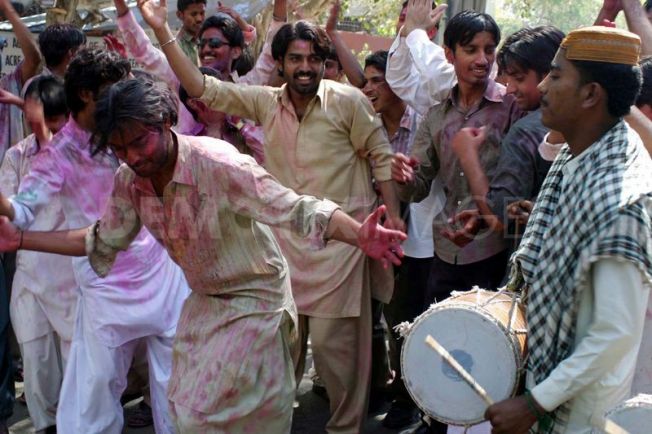
Holi celebrations in Sindh
   Unlike other assets this one is something that the right-wing establishment religiously despises and reckons as Sindh’s greatest sin and calls its inhabitants infidels and Indian agents.
   Sindh has seen little calm and rare self-rule on its soil since time immemorial, but it has been resilient enough so far to protect its most enviable treasure trove – something widely defined as secularism, the art of peaceful co-existence.
   Unlike the most of Pakistan, Sindh is still largely a pluralistic, secular and liberal society. People here too kill others on trivial reasons but at least politically aware Sindhis are not yet convinced to kill each other on religious grounds.
   That tradition goes on; but will it continue hopping like it did in the past centuries? There are serious doubts and concerns as well-laid grand plans are there to create smaller Taliban havens in parts of this land of Sufis – if not possible to fully convert it.
   The planners – well entrenched in the country’s ruling machine and their spare parts in apparently non-state junk – have particularly targeted Sindh’s upper districts, infested with tribal customs largely forced by the migrants from neighbouring provinces, the victims of blatant corruption and negligence by the parties they vote for and abject poverty which is increasingly reaching the tipping point.
   Past events show a disturbing increase in the migration of Sindh’s Hindus to India and elsewhere because of their systematic kidnapping for ransom and abductions and forced conversions of their girls by influential mullahs and feudal lords who blatantly preside over hordes of gangs of robbers in the region.
   Rights activists say hundreds of cases of kidnappings and forced conversions of Hindus and their girls have been committed in the past four years in the northern districts of Sindh, most of which have gone unreported and attracted little attention from the so-called national media, which itself boasted to be centre-right and custodian of the country’s ambiguous ideological borders.
   The events have forced Hindus to migrate in flocks from their soil, a further dent in Sindh’s pluralistic society, which had already suffered a great deal because of migration of its entire middle class – happened to be Hindus – to India in 1947 after the partition of the Subcontinent.
   The dilemma of Sindhi Hindus is that they are often ignored by the world in the times of distress. Pakistani Christians suffer religious indiscrimination and persecution as well, but fortunately the Mighty West follows the same faith and often raises voice for their rights. Our Hindus are already labeled by the patriots in the establishment and media as the Indian agents, thus find no brotherly support from anywhere except for sporadic faint voices from rights organisations and individuals having little influence in bigger arena to change their fate.
   The killing of three Hindu men in the town of Chak in Shikarpur district is considered as the worst incident in decades. Media reports splash several contradictory facts, ranging from personal enmity to the possibility of a victim’s affair with a girl of an influential tribe, but the fact remains that it is bound to accelerate Hindus’ migration. The fact is that this migration will further erode Sindh’s claim to be the country’s only hope for minorities; the land which has always soft spot for minority faiths.
   Whatever the reasons are claimed to have caused the tragedy; the ultimate beneficiaries will remain right-wing mullahs and feudal hypocrites – in terms of their influence and the booty they would ultimately own and share as they did during the mass migration of Hindus 64 years ago.
   These killings should be taken in line with several attacks on NATO trucks in the same district – Shikarpur – as was a suicide blast on Ashura at a Shiite mosque there last year, which fortunately killed just the attacker.
   Being optimistic helps lessening the intensity but pain remains until it is fully cured. The reaction against the Shikarpur killings shows a distinct majority still sides with Sindh’s pluralistic history with intentions to safeguard it. Several demonstrations in scores of towns against the killings are because people don’t want the land to be deprived of its habit to remain peaceful.
   But fear still remains inward as being liberal is something that deep state has little desire to let it go. Pakistan is the land where designs often mirror opposite to the desire of majority; where a tiny minority decides about the national interests and everyone has to follow the suit to remain a patriot – thus alive!

Wednesday, September 5, 2012

Karachi musical makes song and dance of gang wars

by Hasan Mansoor
A hit musical about gangland violence in Pakistan’s largest metropolis is bidding to revive Karachi’s once-rich stage culture while shedding light on its grim addiction to violence.
Fierce sectarian and ethnic conflicts have been responsible for the deaths of more than 1,000 people this year alone and are an all-too-familiar tale to Karachi’s 18 million residents.
But the gritty realism portrayed in “Karachi — The Musical” has nevertheless provoked a huge response, playing to large audiences since it began in October for a month-long run due to finish on November 13.
It tells the story of a rookie boxer from the eastern city of Multan who comes to train at a boxing club in Karachi’s notorious Lyari neighbourhood — better known for its mafias than its sporting talent.
The ambitions of the protagonist, Saif Salaam, spark tensions between his coach and Daud Islam, a mafia don who controls the local gambling, drugs and prostitution rings and wants to thwart the boxer’s success.
With many twists and turns in the story set to a dozen songs, Daud attempts to kill Salaam, just as he had murdered another rising star 20 years earlier.
Mirroring grim realities on Karachi’s streets, the mafioso Daud is only stopped from killing the boy thanks to the intervention of another bad man — a more powerful don whose influence reaches higher into the corridors of power.
“It depicts the situation which we are facing nowadays,” said one theatre-goer, Aleem Akhtar.
“We are infested with mafias and gangs of killers and every mafia is well protected, so we can survive only with the blessings of some good bad men.”
The director of the first original musical to grace the city said that the show represented a defence against the very harshness it was based on.
“Today, art needs more support than ever in Pakistan because it is not only a reflection of the times we live in, but also of a brighter future we can create,” said Nida Butt.
“Theatre is not for the faint-hearted — it’s a labour of love, long hours and hard work that often results in more (money) spent than earned,” she added.
The once-thriving stage scene in Karachi, which was known for its opera before the partition of British India to create Pakistan in 1947, was lost largely due to the growing Islamisation of the country, say artists.
They particularly point the finger at military dictator General Zia-ul Haq, blaming him for worsening the gun and drug culture, encouraging sectarian and ethnic parties and crushing liberal forces during his 1977-1988 rule.
Art began losing its way under Zia’s predecessor Ayub Khan, they say, but it crumbled as culture became an early casualty of Zia’s regime, which nurtured religious fanaticism.
Syed Ahmed Shah, who heads the Karachi Arts Council and whose theatre is staging the production, says his organisation is the only one with a dedicated auditorium for plays and theatrical performances in Pakistan’s biggest city.
“Our resolve is to fully revive the city’s old cultural status so that it is here to stay,” he said.
“Particularly in a situation where fear and anxiety are the order of the day. Culture is the only remedy to rely on,” he said.
Hamza Jafri, who composed the original scores, said that “Karachi – The Musical” drew on the various strands of the city’s musical culture — a mix of rock opera, indigenous beats and big band jazz.
“The music is edgy, contemporary and completely inspired by our research into Lyari and the boxing gangs there. The songs talk about us, about Karachi and our lives in this city today,” he said.
But those living among the conditions depicted on stage complain they cannot see it because they are priced out of the market, with tickets costing 1,500 rupees (18 dollars) each — five times as much as a first-class cinema seat.
“I would love to watch such plays but it is getting too tough to enjoy theatre and cinema nowadays,” said Maula Bakhsh, 35, a fruit vendor in Lyari.
“We hardly feed our families because of price hikes. How can we spare money to spend on that luxury?” said Bakhsh — adding that he had to abandon his own boxing career to support his family.
AFP

Saturday, September 1, 2012

NATO attacks fuel American flag business in Pakistan

by Hasan Mansoor
   In Pakistan a row about American attack on the country’s vague and much-trumpeted sovereighnty means booming demand for replica American, Indian and Israeli flags to go up in flames at protest rallies.
   That means one thing for 31-year-old Mamoon ur Rasheed — business — and he is working long into the night to churn out the paraphernalia beloved of Islamic activists taking to the streets.
   “I have nothing to do with any political party, but it is really enjoyable when you see your work on TV screens,” a laughing Rasheed said.
   “I’m busy every day making banners and placards for different religious and political parties, but work gets a boost — especially when international controversy concerning Muslims breaks out,” he said.
   Two years ago, when a Facebook user decided to organise an “Everyone Draw Mohammed Day” competition to promote “freedom of expression”, it sparked a major backlash among Islamic activists in the South Asian country of 170 million.
   Islam strictly prohibits the depiction of any prophet as blasphemous and the row sparked comparison with protests across the Muslim world over the publication of satirical cartoons of Mohammed in European newspapers in 2006.
   Several hundreds Pakistanis have taken to the streets at the behest of right-wing religious groups, who turn to Rasheed when they need flags to burn and banners to write.
   “Generally, we receive orders for banners for a couple of demonstrations a day, but due to the NATO attacks on Pakistani soldiers and blasphemous drawings issue, which causes spark time to time, the number of orders for flags and banners increases manifold a day,” said Rasheed.
   “Flags are made for burning. They symbolise what our clients want to express and we are paid for it, so I’m happy to see our work go up in flames.”
   Rasheed owns a workshop where he employs four craftsmen to paint flags and write calligraphy, and a small printing press.
   “We have received continuous orders for American and Israeli flags. Normally we paint them but when demand surges into the hundreds we print these flags to get them to our clients in time,” he said.
In the wake of the controversy caused by the NATO attack inside Pakistan, have blocked supplies for NATO forces to Afghanistan through its territory and mulls over to expel Americans from its Shamsi airbase.
   Although none of the protests has mobilised the masses, sporadic demonstrators have continued to vent anger in Karachi and other cities.
   Rasheed runs his business on times of stress. Different periods mean demand for the flags of India — Pakistan’s deepest rival with whom the country has fought three wars — Norway and Sweden, and former colonial ruler Britain.
   Five years ago, widespread protests broke out in the conservative Muslim nation over satirical cartoons of Mohammed that were published by a Danish newspaper and then reprinted in other European countries.
   Then in 2008, thousands of Pakistani Islamists rallied against an anti-Koran film made by a far-right Dutch lawmaker. Another focal point for anger has been Swedish artist Lars Vilks, who etched a blasphemous caricature.
   Whenever elections approach or protests start, wholesalers stock huge quantities of cheap cloth and reap handsome rewards.
   “We are getting bigger orders from scores of painters and printers nowadays,” cloth merchant Mohammad Siddique said.
   “Pakistan is the country of protests and for this Karachi is undoubtedly its capital and our business gets a boost in such circumstances,” Siddique said.
   Waqar Ahmed, owner of a printing press in Karachi’s southern neighbourhood Pakistan Chowk, says orders are flooding in for posters, pamphlets and placards, temporarily overtaking his main business in books and wedding cards.
   “I get orders for pamphlets and posters in the event of controversies or elections,” Waqar says.
   “I have got some orders to print flags of United States – in hundreds – during the ongoing rallies. We have also sold many American and Swedish flags during the protests against Facebook,” Ahmed said.

Thursday, August 30, 2012

They dance in Sindh to capture Punjab!

By Hasan Mansoor

(Written in November 2011)
Shah Mehmood Qureshi can conveniently be regarded as the greatest of all hypocrites and power-hungry individuals who are jumping on Imran Khan’s bandwagon.
   His hypocrisy is evident from the religious allegories he had associated in his speech in Ghotki, where he finally ended his role as the fence-sitter and joined Imran’s Tehrik-e-Insaaf.
   A show in Ghotki can never be applied on the whole Sindh. Ghotki is the smallest of Sindh’s border districts, taken hostage by the influential tribes, whose chiefs are as opportunist and corrupt as elsewhere. They boast on honour killing of women and harbour and nurture criminals to keep people in distress and manipulate election results to their own advantage.
   Local people confirm that majority of the participants of Qureshi’s rally were unknown to them. They had been transported in trucks and lorries from the bordering southern Punjab’s towns.
   “Some of the participants were provided by the influential Mahers of the district, while the rest might form the total supporters of Qureshi who revere him because of his being a gaddi-nasheen of a shrine,” a local political observer told me.
   This rally cannot be regarded as something, which reflects a change in the mood of Sindhis. Both Qureshi and Imran Khan stick to their guns against the government. They spoke of the so-called corrupt practices being committed by Zardari’s government, bragged about their being the clean entities and hit hard against the Sharifs.
   Actually, they discussed Punjab’s politics in Sindh. Both the PTI leaders have stakes in Punjab and they see little prospects in Sindh, the question remains why they chose a place elsewhere to fight for Punjab? Qureshi wanted to show his popularity on trans-provincial scale while Imran was keen to see his bag gets fully stuffed.
   But, none of them spoke about the worst miseries of Sindh caused by the floods the second year running. They talked about the ambiguous NRO controversy, war on terror, United States, Pakistan’s vague sovereignty and Afghanistan and Iraq but deemed it inappropriate to talk on the real problems of Sindh.
   Qureshi, on the occasion, went on to the religious allegories in his speech, which hardly impress Sindhis’ secular minds. Spectacular of all was when he put himself in the shoes of Central Asian warrior Mehmood Ghaznavi by saying he would attack on Somnaath’s temple. He said his rally’s day coincided with the advent of the holy Islamic month of Muharram which, according to him, was a good omen to the country’s secured fate.
   Qureshi received an immediate bashing from across the southern province’s intelligentsia who condemn him for his desire to attack a temple no matter that was a clichéd symbolic notion.
   “Sindhis have always respected the worship places of all faiths and cannot tolerate or appreciate such clichés, which have been created and safeguarded by the powerful establishment,” said one of several statements published in the Sindhi newspapers.
   Sindhis have the history not to support the religious bigots. They still keep their religion and routine life separate despite the deep state’s repeated attempts to corrupt it through the kidnapping and persecution of minority Hindus and their girls’ forced conversion by the mullahs whose sanctuaries are being expanded systematically.
   Imran might take time to keep his finger on the pulse of Sindh, but why Qureshi went so aggressive in his panegyric to his brand-new leader, though he is well accustomed to the Sindhi environs. He is in the process of changing his posture that suits his new party’s right-wing propensities. He wants the people to forget his popular images with Secretary Hillary Clinton showing him sharing broad smiles with his then counterpart whom now he strategically despises.
   One should admire Zardari for his prudent decision in 2008 not to select Qureshi as party’s nominee for the country’s next prime minister. Zardari must have foreseen Qureshi’s hypocoristic leanings that many critics did not.
   But, haven’t Imran started sipping hypocrisy when he gives a clean chit as the foreign minister to Qureshi in Ghotki, an individual whom he had criticised him in his book “Pakistan A Personal History”.
   He writes: “These loans, along with US and European aid money, are like bribes to the Pakistani political elite to keep fighting America’s war for them. This was painfully evident when in October 2010 Pakistan’s foreign minister Shah Mehmood Qureshi told the European parliament: ‘If you want to help us fight extremism and terrorism, one way of doing that is making Pakistan economically stable.’ Pakistan’s ruling elite threatens the West with fears about Islamic militancy to extract more money out of them.”
   We should still admire Imran Khan, after all, he is the saviour we the poor souls have been waiting for the salvation!
Ends

Wednesday, August 29, 2012

Pakistanis resist creeping media vigilantism

by Hasan Mansoor
Most Pakistanis dislike the police, blaming them for being corrupt and aggressive -- but now the media is earning a similar reputation for its frequent attacks on people's privacy.
   Pakistan's ever-growing freewheeling private television stations have given birth to "vigilante journalism" aimed at exposing people -- often ordinary members of the public -- they say are breaching social morals.
   Former military ruler Pervez Musharraf liberalised the media in 1999, opening the way for the first time to private news and entertainment channels. There are now more than 80, 40 of them broadcasting round-the-clock news in five languages.
   In January, TV anchor Maya Khan caused a storm of protest with her show "Raid in the Morning", in which she and a group of veiled women chased couples in a park accusing them of behaving immorally.
   Many fled, but Khan pounced on one couple and badgered them with questions, tricking them into answering by telling them the camera was not running.
   The show provoked furious criticism on social networking websites Facebook and Twitter, and eventually a 5,000-name petition forced bosses at Samaa TV station to sack her.
   Khan refused repeated requests to talk to AFP, but in an interview with Express TV she was unrepentant, saying what she did was in the public interest.
   "My heart is satisfied because whatever I did was done for the betterment of society. But, still if it hurt people, I apologise," she said, insisting that what she presented on her show was "not real but a re-enactment" of the perceived events.
   Pakistani liberals praised Samaa for getting rid of Khan, but their celebrations were short-lived as she was quickly hired by another station, ARY, to host their morning show.
   The Khan incident is typical of stunts carried out by television stations who say they are safeguarding social morals in what is a deeply conservative country.
   Morning shows, such as Khan's, are the most popular. Hosts are well paid and eager to hold onto their audience in a competitive market.
   "Which is why, highly-paid anchors go for ventures like Maya Khan to keep business going," one senior official at a private channel told AFP on condition of anonymity.
   But Mehnaz Rehman, a director of the Aurat Foundation, an organisation which fights for women's rights, said it was a dangerous trend that threatened social order.
   "This is not journalism, this is purely vigilantism, something that does not suit good people, especially those who claim to be fighting for the rights of masses," she said.
   "Media should be responsible and think beyond commercialisation, especially where it hits the society's very social fabric."
   In a country where young people already feel intimidated by intolerance, 25-year-old Mohsin Haleem, an executive, said media has harassed rather than empowered them.
   Pakistan has suffered since the 1970s from encroaching Islamisation that has made society, particularly in the cities and particularly for women, more conservative.
   While the Internet, and sites such as Twitter and Facebook provide some interaction, gender segregation is common and public entertainment is limited.
   "The events of vigilantism by our TV channels have discouraged many of our youth to go in public parks, even they preferred to stay elsewhere on Valentine's Day," he said.
   It is not only courting couples that have been on the receiving end of intrusive television exposes.
   Ghulam Haider works in a health diagnostics laboratory which has been gatecrashed twice by reporters from two different TV channels insisting on filming the premises to check the facilities -- an act only the government is authorised to take.
   "They are more assertive and ruthless in attacking us in the name of freedom of expression. They don't respect our freedom and individual liberty," said Haider, 69.
   "The reporters take booms in their hands and gatecrash anywhere without permission. They especially do this in the places which are inhabited or owned by those having little influence in the society," Haider said.
   Talat Hussain, who hosts a political show on Dawn TV, is an exception to the trend and has exposed media vigilantism.
   He was the only anchor to dedicate an entire show to the Khan story.
   But while he says that shows like Khan's break boundaries and intrude, he believes the media has the potential to correct itself.
   "We are a young and evolving media. The action by a TV management to fire the host for chasing people shows that potential of self-correction and self-accountability," he said.
   "Any reporter who intrudes into the privacy of people should realise, if they continue to do this the market will turn against us."
Ends

Thursday, December 22, 2011

Liberal parties, Taliban anchors on the same page!


   By Hasan Mansoor    
Conspiracy theories are abound on the notion of involving the army in Karachi's bloody game to quell the incessant violence. Apart from the opponents and proponents of the demand to introduce khakis in Karachi's bloody game, some conspiracy theorists oppose it because they fear that could put the military in a mire and may lead to international forces to intervene and make the metropolis a city of their desire!    Interestingly, the Awami National Party (ANP) and the Muttahida Qaumi Movement (MQM) that had been staunch opponents and victims of the army operations - overtly or covertly - in civilian populations, desperately demand khakis to take over Karachi.    The two parties must have seen a magical wand in the hands of General Ashfaq Pervez Kayani that can instantly make the city a haven and destroy the hovering evil.    It gives an impression of a football match where sides have been changed for the competing teams in second half of the game. The ruling Pakistan Peoples Party (PPP) has been blamed for encouraging the military on several occasions in the past to settle civilian unrests.    Critics blame the PPP for siding with dictators Ayub Khan and Yahya Khan and played catalyst to get Pakistan rid of its eastern wing. Peoples Party leadership sent soldiers to the hills of Balochistan and only take a lesson when a monster called Zia-ul-Haq put its leader ZA Bhutto in a body bag to his sizzling native town Garhi Khuda Bakhsh.    President Zardari's ruling party now explicitly dismisses the demand of its allies to get the army involved to quell Karachi violence.    For critics who take the PPP's reluctance by utter surprise seem to have a weak memory. It was Nawaz Sharif and not Benazir Bhutto who had ordered for a military operation in Karachi mainly against the MQM.    Benazir had rather used the police to bring peace in the troubled town by assigning her macho minister Naseerullah Baabar to take over the proceedings.    The wisdom behind using police to restore civilian order was not as complicated as Einstein's Theory of Relativity. Signifantly, that happened following army's latest failure -- for obvious reasons of course. Soldiers are trained to combat along the borders, consider the rival as a condemned enemy and moving in formations and fronts.    That training bears no fruit when a soldier sees himself stuck up with the "enemies" around living in houses established in congested and dark alleys and bylanes. There are no fronts, no formations, no "strategic depth" and little intelligence. The most disheartening fact for soldiers is that their 'enemies' are not willing to combat in the manner they have been taught of. A hit-and-run guerilla technic is something that has always frightened the armies. It prolongs a war, frustrates the professional soldiers, consumes their skills and tools and fatigues them to the core.    Pakistani army's defeats and retreats in Bangladesh, Balochistan, Khairpur Nathanshah and Karachi manifest the notion that a civilian unrest could only be quelled through civilian means and discourse.    Like PPP, Nawaz Sharif is opposed to the military take over of Karachi showing he has learnt a lesson as well, with his misadventure in the country's largest city and economic engine. But, interestingly, on one side Chaudhry Nisar, the opposition leader in the National Assembly, is equally opposed to the military campaign, the PML-N leaders like Khawaja Asif and Mehtab Abbasi -- both are committed televengalists -- have ensured Kamran Khan, a civilian representing GHQ on Geo News, that they would convince Nawaz to support military in Sindh capital.    Who wants the army to make a second stunt in Karachi? The MQM, the ANP, a section of business community, particularly the ones who rhyme with dominant political party in the city, and a band of anchorpersons of filthy private TV channels who are influencing their agenda on people, whose majority is apolitical, just desiring peace to make a safe living.    As Imran Khan still swings in between, the Jamaat-e-Islami finds a shift in its earlier stance and now endorses the stance of Nawaz Sharif and JUI's Fazlur Rehman - not to send the army.    The question arises whom the anchorpersons represent who are dying to see the thunder of boots on Karachi streets. The loyalties of the TV anchors - popularly known as members of the Taliban Union of Journalists - is unquestionably clear. Their mindset is clearly in marked contrast to the secular MQM and ANP.    So, a common demand from the Taliban anchors and liberal political parties to invite armed forces in Karachi has done wonders to shrug off many ambiguities inside many. The riddle is solved and anyone can see who controls the puppet show.    The corps commanders' 'concern' over the events in Karachi is not a distant past. So is the statemnt of the army chief showing his will to step in if the civilian government asked for it. The hue and cry spewing from TV screens is visibly something to rake the government over the coals and force it request the GHQ to enter the scene.    Saner voices like that of Asma Jehangir were in a minority when she had opposed to bring peace through the long boots, but interestingly, her supporters are on the rise now after PML-N openly opposed an army operation.    Let's see whether the Supreme Court brings peace in Karachi. Surely, taking cognizance of the killings by the Chief Justice has already booked his place on the front pages of newspapers.

Wednesday, December 21, 2011

TV accused of fanning Pakistan political instability


by Hasan Mansoor
Pakistan's television networks are heaping political pressure on an increasingly unpopular President Asif Ali Zardari with critical and influential programming that pretend to offer a voice to the poor. In the decade since military ruler Pervez Musharraf issued licences and softened state control on media after seizing power, more than 50 channels have mushroomed in the country, with around half dedicated to news broadcasts. The channels have become campaigners against the leadership, have whipped up fervour for and against the Taliban, have embarrassed the security services and sown fear with 24-seven coverage of attacks beamed into living rooms. "The government is under constant pressure from the media," Mutahir Sheikh, head of international relations at Karachi University, says. A Gallup survey claimed that more than half of Pakistanis -- 57 percent of those polled -- blame the media for stirring up political instability in the country, which has known regular periods of military rule.    There are dozens of private satellite channels based in Pakistan and abroad that present every possible political opinion, pumping out news and debate in Urdu, English and provincial languages to the country's 170 million people. Owned by newspaper groups, wealthy businessmen and private individuals, critics accuse them of sensationalism and peddling conspiracy theories, particularly about perceived interference from India and the United States. Renowned author Ahmed Rashid accused talk show hosts of "demonising the elected government, trying to convince viewers of global conspiracies against Pakistan led by India and the United States or insisting that the recent campaign of suicide bomb blasts... is being orchestrated by foreigners. "The campaign waged by some politicians and parts of the media -- with underlying pressure from the army -- is all about trying to build public opinion to make Mr Zardari's tenure untenable," he had written on the BBC website. authorities banned a Dubai-based show presented by an outspoken critic of the government on Pakistan's most influential private channel, Geo. "The government is unnerved and uneasy over the independent criticism it faces in our unbiased programmes. But instead of countering argument with argument it goes for tactics which bring more embarrassment," said Azhar Abbas, Geo's managing director. In 2009, the authorities cut live footage broadcast by some TV channels of a deeply embarrassing 20-hour siege on the Pakistani army's headquarters. Television channels were seen as having influenced a government decision to publish a list of officials, including Zardari, who have benefited from an amnesty on graft accusations. Now, they extensively propagate every case in the Supreme Court, which could embarrass the authorities. Many say the media play a vital role in shaping public opinion in a country where nearly half the population are illiterate. "Independent media has empowered the underprivileged people to express themselves, which is itself a revolutionary change," said Fateh Muhammad Burfat, a sociology professor at Karachi University. "But, at the same time, it carries along its own agenda and influence people to buy it." The channels supported a movement to restore ousted Chief Justice Iftikhar Muhammad Chaudhry in 2009, siding with opposition leader Nawaz Sharif until Zardari's government caved in, reinstating him to avert violence in the capital. Television executives believe their news helps inculcate democracy and gives a voice to the disenfranchised, who get little assistance from the state. "We adopt very democratic methods. Here you find people from both sides," said Talat Hussain, a top official and anchorperson at Dawn News. "The impression that we create chaos in society is not true," said Hussain. "In Pakistan people have utmost faith in two institutions -- judiciary and media. Our people pin their hopes on us and we do whatever we can to make ours a better society," said Hussain.