Showing posts with label Violence. Show all posts

Thursday, October 4, 2012

Prices take shine off Pakistan weddings

by Hasan Mansoor
   Pakistan’s traditionally lavish weddings have lost their sparkle this matrimonial season thanks to rising prices of gold and festive essentials in a limping economy overshadowed by Taliban attacks.
   The colourful celebrations normally span three to five days and attract 500 to 1,000 guests, pushing the cost for the hard-hit lower middle class to between 300,000 and one million rupees (3,400-11,000 dollars).
   “It has become too expensive. Everything is expensive. Even a simple wedding could break the back of poor people like me,” said Mohammad Aslam, 62, a retired government employee.
    Aslam spent most of his pension on marrying off his elder daughter, forcing him to borrow 200,000 rupees to help fund his second daughter’s wedding.
   A large part of the spending goes on gold jewellery, as in other South Asian countries, but sales are down partly because of rising global gold prices, businessmen say.
   Gold surged to a new record high of 1,780 dollars an ounce during international trading in October 2012.
   “Four years ago there was a demand for 7,700 ounces of gold daily, only for making jewellery in Pakistan. But now it has substantially decreased,” said Haroon Chand, a leading member of the country’s jewellers’ association.
   Imports of gold through Dubai, which was Pakistan’s main source of the metal, have fallen significantly, he said.
   “Affluent and middle class people have halved their spending on jewellery.”
   Poor families usually have their old jewellery redesigned for the weddings of their children, he noted.
   “I tried to skip some of our customs to reduce the cost of my son’s marriage, but I couldn’t because of family pressure,” Ahmed Ali, a car mechanic, said at his son’s wedding in Karachi’s Ranchore Lane.
   “My wife wanted all that because he’s her only son. My son is also a mechanic and we have decided to repay the loans jointly as soon as possible.”
   Pakistani families spend lavishly on gifts for the happy couple, food for guests at wedding events that drag on for days, or on a sumptuous dinner offered by the groom’s family at a wedding hall.
   “What disturbs me most is that my daughters have also reached adulthood and their marriages will only be possible by taking more loans,” said Ali.
   “Like me, the bride’s family has also taken loans for the marriage. We are all prisoners of our customs,” he added.
   Chand blamed deteriorating law and order, increased taxes on gold imports, the weakening purchasing power of ordinary people and higher global gold prices for dealing the business “a big blow”.
   Falling gold sales have seen people like Mohammad Akram, 33, laid off.
   Until recently he worked as an artisan at a leading jewellery shop in an upscale neighbourhood of the teeming financial capital Karachi, a city of 18 million people that sprawls by the Arabian Sea.
   “I am a skilled worker but am forced to ply a rickshaw to support my children,” Akram said.
   But Nauman Ahmed says business has boomed at his costume jewellery shop during this year’s wedding season, between the Muslim feasts of Eid al-Fitr and Eid al-Adha, because its fashionable designs are “cheap and affordable”.
   Instead of gold, people are increasingly opting to buy silver and costume jewellery, mostly imported from China and India, Chand and shopkeepers said.
   Escalating food prices have multiplied the cost of wedding banquets, with economists blaming Pakistan’s general economic downturn and militant attacks.
   Independent economist A.B. Shahid said such hurdles, including ineffective government policies, may prevent Pakistan from meeting the official 4 percent growth target this fiscal year, which ends June 30.
   Taliban and Al-Qaeda-linked extremists have carried out a five-year campaign of attacks that have killed more than 5,000 people in Pakistan, a country of around 170 million people.
   “Terrorism in our country has highly affected our economy. Our people cannot spend much and this situation could persist until we succeed in curbing militancy,” Shahid said.
   Pakistan’s economy grew by two percent last fiscal year, the lowest rate in a decade, but even that level may not be attainable this year, Shahid said.

Thursday, September 20, 2012

Private security booms in violent Pakistan

by Hasan Mansoor
   Karachi, Pakistan’s buzzing port city, is a hub of beaches, malls, restaurants — and the odd shooting range where an army of private security guards train to protect the well-heeled.
   As growing insecurity grips the nuclear-armed nation, with the military battling Taliban rebels in swathes of the northwest, deadly bombs hitting key cities and crime on the rise, the security industry in quietly booming.
   Rashid Malik, who owns the firm Security 2000, has his men carry out target practice in the basement of a bungalow in an upscale Karachi neighbourhood, but even with 10,000 employees, he is struggling to keep up with demand.
   “I have to turn down many requests from people and businesses because I still have not enough capacity to provide security to all the people,” said Malik, a retired army brigadier.
   “After the army and police, private security guards are the third largest force in Pakistan — we are just a few years away from outnumbering the police force in the country,” he adds.
   There are 600 security firms in Pakistan, according to figures from the All Pakistan Security Agencies Association (APSAA), with 200 of them operating in Karachi, protecting businesses big and small, as well as the homes of wealthy clients.
   Karachi — Pakistan’s biggest city with a population of about 17 million — was once known as the City of Lights and is the country’s economic engine, but has been plagued by sectarian and ethnic tensions for years.
   Clashes among mafias and ethnic groups left at least  1,200 people this year.
   Now, the threat of terrorism also grips the city, with attacks by Islamist extremists gathering pace after US-led forces ousted the Taliban regime from Afghanistan in late 2001.
   More than 5,000 people in Pakistan have been killed in less than two years in attacks linked to Taliban and other extremist groups, and Karachi has not been spared.
   In January 2002, Wall Street Journal correspondent Daniel Pearl was kidnapped in the city while researching Islamist militancy in the wake of the 9/11 attacks in the United States. A video showing him being beheaded was delivered to the US consulate in Karachi nearly a month later.
   The city has also seen a string of other incidents, including suicide attacks on French engineers, the US consulate and a bomb targeting late politician Benazir Bhutto in October 2007 which killed 139 people.
   Series of attacks on naval assets, including a 17-hour seige of its airbase — the country’s nukes were not far-off — by Taliban militants before attack on a top counterterrorism cop are just a few to mention.
   “Our business witnessed huge prospects after the 9/11 attacks,” said Malik, who also heads the APSAA.
   The city is also seeing rising crime, including robberies and kidnappings.
   “There is a serious law and order situation in the whole country, which has left us with no other option but to buy security to secure our lives and our huge investments,” Mohammad Ali, a steel importer, told AFP.
   For 170 million Pakistanis, there is just a 383,000-strong police force. In Sindh that figure is 99,000 police, while there are 100,000 security guards patrolling the streets of Karachi and the rest of the province.
   Most officers are ill-trained, poorly educated and badly paid — a regular constable’s monthly salary is just 100 dollars, and his family receives a lump sum of 6,000 dollars if he is killed in the line of duty.
   “We have hired security guards for our safety because police have failed to stop criminals from robbing and killing people,” said Mohammad Waseem, a resident of the city’s central Gulberg neighbourhood.
   On his street, private security guards man a kiosk at the corner, letting only those living in the area pass through.
   “You can see this arrangement in most areas of Karachi,” Waseem said.
   Malik said one problem was getting trained guards.
   “Most of our guards are ex-military soldiers but that does not meet our increasing demand so we have to go to Punjab and North West Frontier Province (NWFP) where people acquainted with weapons could be found easily,” he said.
   The country’s lawless tribal areas and several other NWFP districts are currently plagued by a Taliban insurgency.
   The Pakistani army is engaged in an operation to quell an uprising across the tribal badlands, and the Taliban have vowed to avenge the onslaught with attacks on major cities.
   Sociologist Fateh Mohammad Burfat said that in uncertain times, residents take comfort from the presence of uniformed security guards standing on street corners of the cosmopolitan city.
   “Insecurity among the people has increased. They obviously need to do something to feel secure,” said Burfat, who teaches at Karachi University.
Little money, risks aplenty!
Abdul Hakim, a 35-year-old man, is one of around 30,000 security guards employed with a security agency operating in Karachi, and gets a paltry 4,200 rupees after exposing himself to dangers for full 30 days.
“I have to support my family of four and this amount is just nothing to run a house,” Hakim says.
He says he is in search of a relatively better job because the earnings are far too little to stick with the business.
“It is a better job for young bachelors, but not for married men who have to support their families,” he says.
Hakim’s wife is good at embroidery and works at a vocational institute as a teacher. Her earnings enable the couple to send their two children to school and ensure a proper living.
Hakim was originally a carpenter but his employer wound up the business and then he started his own business without opening an outlet. He could get some orders in the beginning from his old clients at home, but soon his source of income dried up.
“A time came when I could get an order after many months, and then I realised that I had virtually become jobless,” he says.
Hakim says most people now prefer readymade furniture and do not take the trouble to visit carpenters.
“I did contact some manufacturers for the job, but they offered little money and demanded full day work, which I did not accept,” he says.
Hakim then saw an advertisement of a security agency in a newspaper and got a job there. He spent some time with trainers and then joined his colleagues to roam around and guard one or another client.
“Initially, I thought it would have been too simple a job, but now I realise it gives great tension and pays almost nothing,” he says.
All the security agencies have identical harsh terms and conditions for their employees. The guards have to perform 12-hour duty daily instead of the set standard of eight hours a day.
The owner of a security company insists the agencies pay ‘handsome’ money to their employees.
“We know they do a tough job, but we compensate them by paying them Rs 4,000 or more as monthly salary, which is more than the minimum daily wage as mentioned in the labour laws,” an owner says.
He says the minimum wage set in the labour laws for a worker is Rs 4,000. Besides, security companies also pay overtime equal to the daily wage.
Given a 12-hour daily duty if a guard wants to venture into overtime, he has to perform 36-hour continuous duty to add Rs 130 to his monthly salary.
“It is very difficult and only some young and daring people could brave it,” Hakim says.

Friday, September 7, 2012

Seperate prisons for jihadis

by Hasan Mansoor
Experts involved in operations against Islamist militants and sectarian terrorists have suggested that the government should set up a separate jail for hardcore militants of banned outfits. They want to establish at least one prison in each of the four provinces where such elements could be kept under the watch of professional jailers.
“We need to make special arrangements to keep these elements separate from other inmates,” one of the few investigating officers in the Sindh Police, who has been attacked a number of times by militants of the banned organisations, told me.
He says jihadi and sectarian militants have long memories and carry out revenge killings whenever they find an opportunity and that “our normal jails offer such opportunities in abundance.”
There are many instances in the recent past in which these prisoners attacked jailers while their comrades outside the jail made numerous attempts to get their arrested colleagues released by attacking custody vans on the way to or from the courts.
“It is time to establish a high-security prison for such hardened elements,” ex-chief of the prisons in the Sindh province, Nisar Maher, had suggested during his tenure years ago.
Maher had said his department did not have sufficient funds to establish a detention centre exclusively for jihadi and sectarian militants but was of the opinion that the government should do something in this regard. “At least we should have some place where these inmates could be kept separate from other prisoners,” he had then told me in an interview.
Sources in the interior ministry in Islamabad say due to certain ‘disturbing facts’ the central government is seriously contemplating the matter. American FBI officials had also suggested separate detention centres for Islamist militants after its experiences in Pakistan.
During an operation to track down Al Qaeda operatives in Pakistan when the War on Terror became a rage, FBI and CIA officials while monitoring and scanning air and satellite signals detected some unusual signals from a Pakistani city. After intercepting the message, the cell started tracking down the place from where the coded call had been made via a satellite phone. The Americans passed on the information to their Pakistani counterparts who found that the signals were emanating from a prison. The prison authorities discovered that some jihadis were using a phone in their barracks.
According to sources, using a mobile or satellite phone inside a Pakistani jail is not a big deal. “It is a routine matter. I have raided various jails in my province and each time we recovered mobile phones from one prisoner or the other,” a senior prison official says. However, he would not specify whether these prisoners included jihadi militants or not.
“We are living in an era of communication technology and it is easy to get hold of such devices inside the jail because of corrupt officials,” he says adding that his department has planned to introduce ‘public call offices’ inside every major prison in Sindh.
“It is a two-pronged project,” he says, “we will be providing our inmates an opportunity to remain in touch with their families and at the same time leaving those who claim that they keep phones secretly to stay in touch with friends and families outside with no excuse to do so.”
Experts in the investigation wing of the police department, however, are not satisfied with such plans. “Introducing public call offices sounds like a good idea and would certainly benefit ordinary prisoners but it is not going to tame the hardened elements or control their present activities,” a senior investigator says.
“It is not possible to restrict their activities inside the barracks and isolate such terrorists from their comrades until they are placed in special detention centres supervised by reasonably paid professionals whose chances of succumbing to bribery would be minimal,” he says.
Corruption is a major problem in jails. There have been various incidents in which imprisoned hardened criminals were caught with weapons and liquor in their possession. In one of the ugliest incidents that has come to light so far, imprisoned criminals were found with 50 juvenile prisoners in Hyderabed jail. The children had been provided to the inmates with the connivance of the prison caretakers.
According to sources, the presence of corrupt jailers does not preclude such incidents from being repeated. What is to prevent something similar to the Sialkot incident, in which four judges were kidnapped and killed by armed prisoners, from taking place again? “Those were ordinary criminals. If these rogue elements are treated like the ordinary prisoners, the result could be catastrophic,” another investigator says.
Sources say the investigators have found clues leading them to believe that sectarian killings were masterminded by hardcore terrorists in the custody of the authorities. Insiders say the jihadis and sectarian militants have arranged to be held in one barracks where they hold meetings that are out of bounds for jail officials. “In such a situation everything is possible because the jail supervisors are not professionals,” a source said.
I have also learnt that the government has ordered that jail officials be thoroughly checked to ensure that they do not have any past or present links with sectarian or religious outfits. These orders have been issued after it came to light that authorities busted some law enforcement officials with connections to jihadi organisations.
The provincial governments of the Punjab and Sindh are reluctant to take custody of many ‘blacklisted’ prisoners from Haripur jail despite reminders from the NWFP government. According to senior officials, they are wary of taking custody of these prisoners due to security concerns. “Such prisoners are fit to be confined in places where they have no access to corrupt officials or those who have links with religious outfits. We have proposed that the government establish such places,” an official said.

Thursday, September 6, 2012

Sindh’s secularism fights for survival!

   Sindh is rich in minerals, energy resources, forests, desert and sea, having a few high altitude places offering chilling temperatures. All these treasures merit a greedy stare from the suppressing centre, yet they are merely appendages – there re
mains a prized asset!
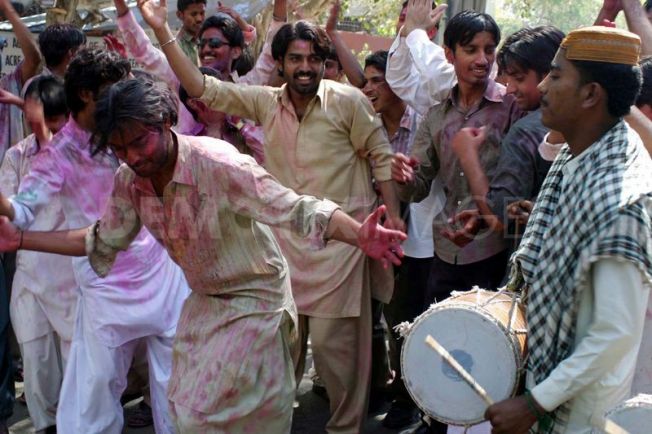
Holi celebrations in Sindh
   Unlike other assets this one is something that the right-wing establishment religiously despises and reckons as Sindh’s greatest sin and calls its inhabitants infidels and Indian agents.
   Sindh has seen little calm and rare self-rule on its soil since time immemorial, but it has been resilient enough so far to protect its most enviable treasure trove – something widely defined as secularism, the art of peaceful co-existence.
   Unlike the most of Pakistan, Sindh is still largely a pluralistic, secular and liberal society. People here too kill others on trivial reasons but at least politically aware Sindhis are not yet convinced to kill each other on religious grounds.
   That tradition goes on; but will it continue hopping like it did in the past centuries? There are serious doubts and concerns as well-laid grand plans are there to create smaller Taliban havens in parts of this land of Sufis – if not possible to fully convert it.
   The planners – well entrenched in the country’s ruling machine and their spare parts in apparently non-state junk – have particularly targeted Sindh’s upper districts, infested with tribal customs largely forced by the migrants from neighbouring provinces, the victims of blatant corruption and negligence by the parties they vote for and abject poverty which is increasingly reaching the tipping point.
   Past events show a disturbing increase in the migration of Sindh’s Hindus to India and elsewhere because of their systematic kidnapping for ransom and abductions and forced conversions of their girls by influential mullahs and feudal lords who blatantly preside over hordes of gangs of robbers in the region.
   Rights activists say hundreds of cases of kidnappings and forced conversions of Hindus and their girls have been committed in the past four years in the northern districts of Sindh, most of which have gone unreported and attracted little attention from the so-called national media, which itself boasted to be centre-right and custodian of the country’s ambiguous ideological borders.
   The events have forced Hindus to migrate in flocks from their soil, a further dent in Sindh’s pluralistic society, which had already suffered a great deal because of migration of its entire middle class – happened to be Hindus – to India in 1947 after the partition of the Subcontinent.
   The dilemma of Sindhi Hindus is that they are often ignored by the world in the times of distress. Pakistani Christians suffer religious indiscrimination and persecution as well, but fortunately the Mighty West follows the same faith and often raises voice for their rights. Our Hindus are already labeled by the patriots in the establishment and media as the Indian agents, thus find no brotherly support from anywhere except for sporadic faint voices from rights organisations and individuals having little influence in bigger arena to change their fate.
   The killing of three Hindu men in the town of Chak in Shikarpur district is considered as the worst incident in decades. Media reports splash several contradictory facts, ranging from personal enmity to the possibility of a victim’s affair with a girl of an influential tribe, but the fact remains that it is bound to accelerate Hindus’ migration. The fact is that this migration will further erode Sindh’s claim to be the country’s only hope for minorities; the land which has always soft spot for minority faiths.
   Whatever the reasons are claimed to have caused the tragedy; the ultimate beneficiaries will remain right-wing mullahs and feudal hypocrites – in terms of their influence and the booty they would ultimately own and share as they did during the mass migration of Hindus 64 years ago.
   These killings should be taken in line with several attacks on NATO trucks in the same district – Shikarpur – as was a suicide blast on Ashura at a Shiite mosque there last year, which fortunately killed just the attacker.
   Being optimistic helps lessening the intensity but pain remains until it is fully cured. The reaction against the Shikarpur killings shows a distinct majority still sides with Sindh’s pluralistic history with intentions to safeguard it. Several demonstrations in scores of towns against the killings are because people don’t want the land to be deprived of its habit to remain peaceful.
   But fear still remains inward as being liberal is something that deep state has little desire to let it go. Pakistan is the land where designs often mirror opposite to the desire of majority; where a tiny minority decides about the national interests and everyone has to follow the suit to remain a patriot – thus alive!

Saturday, September 1, 2012

NATO attacks fuel American flag business in Pakistan

by Hasan Mansoor
   In Pakistan a row about American attack on the country’s vague and much-trumpeted sovereighnty means booming demand for replica American, Indian and Israeli flags to go up in flames at protest rallies.
   That means one thing for 31-year-old Mamoon ur Rasheed — business — and he is working long into the night to churn out the paraphernalia beloved of Islamic activists taking to the streets.
   “I have nothing to do with any political party, but it is really enjoyable when you see your work on TV screens,” a laughing Rasheed said.
   “I’m busy every day making banners and placards for different religious and political parties, but work gets a boost — especially when international controversy concerning Muslims breaks out,” he said.
   Two years ago, when a Facebook user decided to organise an “Everyone Draw Mohammed Day” competition to promote “freedom of expression”, it sparked a major backlash among Islamic activists in the South Asian country of 170 million.
   Islam strictly prohibits the depiction of any prophet as blasphemous and the row sparked comparison with protests across the Muslim world over the publication of satirical cartoons of Mohammed in European newspapers in 2006.
   Several hundreds Pakistanis have taken to the streets at the behest of right-wing religious groups, who turn to Rasheed when they need flags to burn and banners to write.
   “Generally, we receive orders for banners for a couple of demonstrations a day, but due to the NATO attacks on Pakistani soldiers and blasphemous drawings issue, which causes spark time to time, the number of orders for flags and banners increases manifold a day,” said Rasheed.
   “Flags are made for burning. They symbolise what our clients want to express and we are paid for it, so I’m happy to see our work go up in flames.”
   Rasheed owns a workshop where he employs four craftsmen to paint flags and write calligraphy, and a small printing press.
   “We have received continuous orders for American and Israeli flags. Normally we paint them but when demand surges into the hundreds we print these flags to get them to our clients in time,” he said.
In the wake of the controversy caused by the NATO attack inside Pakistan, have blocked supplies for NATO forces to Afghanistan through its territory and mulls over to expel Americans from its Shamsi airbase.
   Although none of the protests has mobilised the masses, sporadic demonstrators have continued to vent anger in Karachi and other cities.
   Rasheed runs his business on times of stress. Different periods mean demand for the flags of India — Pakistan’s deepest rival with whom the country has fought three wars — Norway and Sweden, and former colonial ruler Britain.
   Five years ago, widespread protests broke out in the conservative Muslim nation over satirical cartoons of Mohammed that were published by a Danish newspaper and then reprinted in other European countries.
   Then in 2008, thousands of Pakistani Islamists rallied against an anti-Koran film made by a far-right Dutch lawmaker. Another focal point for anger has been Swedish artist Lars Vilks, who etched a blasphemous caricature.
   Whenever elections approach or protests start, wholesalers stock huge quantities of cheap cloth and reap handsome rewards.
   “We are getting bigger orders from scores of painters and printers nowadays,” cloth merchant Mohammad Siddique said.
   “Pakistan is the country of protests and for this Karachi is undoubtedly its capital and our business gets a boost in such circumstances,” Siddique said.
   Waqar Ahmed, owner of a printing press in Karachi’s southern neighbourhood Pakistan Chowk, says orders are flooding in for posters, pamphlets and placards, temporarily overtaking his main business in books and wedding cards.
   “I get orders for pamphlets and posters in the event of controversies or elections,” Waqar says.
   “I have got some orders to print flags of United States – in hundreds – during the ongoing rallies. We have also sold many American and Swedish flags during the protests against Facebook,” Ahmed said.

Thursday, December 22, 2011

Children sexually abused on Pakistan's streets


by Hasan Mansoor   
Nadeem knows first hand the misery of life on the streets. Sexually assaulted as a child, he became a pimp of young boys -- the only way he knew how to survive as a member of Pakistan's underclass.    He says he was 12 years old when he was attacked. Since then, he has been dragged into a vicious cycle of horrifying abuse allegedly aided and abetted by police and which few are willing to confront in the Muslim country.    "It was just the third night I slept on a street when a policeman picked me up and did bad things to me. I cried a lot but no one came to help me," Nadeem, now 17, told AFP.    He was sexually assaulted for a second time by the leader of a street gang, who then forced Nadeem to join the 17 other children in his gang.    By 14 he was a full-time sex worker. His pimp gave him a mobile phone to keep in contact with clients.    According to charities which work to protect street children in Pakistan, up to 90 percent are sexually abused on the first night that they sleep rough and 60 percent accuse police of sexually abusing them.    "Children on the street are beaten, tortured, sexually assaulted, and sometimes killed," said Rana Asif Habib, head of the Initiator Human Development Foundation (IHDF).    "Police (should) protect people. When policemen are themselves involved in molesting children, who will protect them?" he asks.    "What we have gathered in our research is that policemen make up more than 60 percent of those who physically torment, sexually harass street children," said Anwer Kazmi of the Edhi Foundation, the country's largest charity.    Karachi is home to Pakistan’s biggest community of street children -- tens of thousands of victims of domestic violence and broken homes, drugs and crime, in the steamy port city.    More than 170,000 street children live on the streets across the country.    Illiterate, uneducated and most without family, the children can grow into seasoned criminals, drug addicts or fall prey to Islamist militancy.    When Nadeem turned 16, he tried to escape. He received counselling from a charity and was taught photography. He tried to make it his profession.    "I was happy with my work, but a year ago, a policeman put me in the lockup on a false charge, confiscated my camera and abused me sexually," he said.    The experience turned him against the world.    "I decided to become stronger. Now I have my own gang and many influential people are my clients. No one can touch me now."    Nadeem says he acts as a pimp to 10 teenage sex workers aged 14-18, taking a sizeable cut of whatever the boys in earn.    "Half an hour after finishing with one client I get another call and I forget all about wanting a respectable life."    Nadeem lives on a street in the downtown Saddar neighbourhood, but rents a room in a cheap hotel when he has surplus cash. He confesses that he too sexually assaulted a child.    "He insulted me and my family so I told him he had it coming. So I grabbed him and gave it to him. I still remember that night. I haven't done that to anyone else since then and I don't want to."    Rizwan is a fisherman's son. He insists he is 12, but he looks much younger. He left home three years ago because his family beat him and says he was abused by police. IHDF fears he too will be dragged into the sex industry.    "The police tried to make me do bad things six or seven times but I managed to get away," he said.    "But one day, one policeman took me by force, put a cloth over my mouth and took me to a place where he did bad things."    Shaukat Hussain, head of police in Karachi's southern district where many street children live, said any officers found guilty would be punished, but denied the force was anything like as culpable as reported.    "There are black sheep in our department who are involved in such acts. But we punish anyone whose crime comes to surface and is proved," he told AFP.    "The number of policemen who are involved in such acts is far less than what is being claimed by the media and NGOs," he added.    Pakistan offers little protection to vulnerable children.    "A draft bill for child protection has been pending with the interior ministry for two years," a senior official of the human rights ministry told AFP on condition of anonymity as he was not authorised to talk to the media.    The bill is designed to tighten the laws protecting children, bringing them in line with international conventions, doing more to help children in difficulty and bringing police and other offenders to book for abusing minors.    "There is a visible lack of interest on the part of the government on this issue... despite our constant pursuits," said the ministry official.    One former police official told AFP that he organised seminars to sensitise police on how to treat street children four years ago, but that the programme was abruptly abandoned when he retired. August 2011

Liberal parties, Taliban anchors on the same page!


   By Hasan Mansoor    
Conspiracy theories are abound on the notion of involving the army in Karachi's bloody game to quell the incessant violence. Apart from the opponents and proponents of the demand to introduce khakis in Karachi's bloody game, some conspiracy theorists oppose it because they fear that could put the military in a mire and may lead to international forces to intervene and make the metropolis a city of their desire!    Interestingly, the Awami National Party (ANP) and the Muttahida Qaumi Movement (MQM) that had been staunch opponents and victims of the army operations - overtly or covertly - in civilian populations, desperately demand khakis to take over Karachi.    The two parties must have seen a magical wand in the hands of General Ashfaq Pervez Kayani that can instantly make the city a haven and destroy the hovering evil.    It gives an impression of a football match where sides have been changed for the competing teams in second half of the game. The ruling Pakistan Peoples Party (PPP) has been blamed for encouraging the military on several occasions in the past to settle civilian unrests.    Critics blame the PPP for siding with dictators Ayub Khan and Yahya Khan and played catalyst to get Pakistan rid of its eastern wing. Peoples Party leadership sent soldiers to the hills of Balochistan and only take a lesson when a monster called Zia-ul-Haq put its leader ZA Bhutto in a body bag to his sizzling native town Garhi Khuda Bakhsh.    President Zardari's ruling party now explicitly dismisses the demand of its allies to get the army involved to quell Karachi violence.    For critics who take the PPP's reluctance by utter surprise seem to have a weak memory. It was Nawaz Sharif and not Benazir Bhutto who had ordered for a military operation in Karachi mainly against the MQM.    Benazir had rather used the police to bring peace in the troubled town by assigning her macho minister Naseerullah Baabar to take over the proceedings.    The wisdom behind using police to restore civilian order was not as complicated as Einstein's Theory of Relativity. Signifantly, that happened following army's latest failure -- for obvious reasons of course. Soldiers are trained to combat along the borders, consider the rival as a condemned enemy and moving in formations and fronts.    That training bears no fruit when a soldier sees himself stuck up with the "enemies" around living in houses established in congested and dark alleys and bylanes. There are no fronts, no formations, no "strategic depth" and little intelligence. The most disheartening fact for soldiers is that their 'enemies' are not willing to combat in the manner they have been taught of. A hit-and-run guerilla technic is something that has always frightened the armies. It prolongs a war, frustrates the professional soldiers, consumes their skills and tools and fatigues them to the core.    Pakistani army's defeats and retreats in Bangladesh, Balochistan, Khairpur Nathanshah and Karachi manifest the notion that a civilian unrest could only be quelled through civilian means and discourse.    Like PPP, Nawaz Sharif is opposed to the military take over of Karachi showing he has learnt a lesson as well, with his misadventure in the country's largest city and economic engine. But, interestingly, on one side Chaudhry Nisar, the opposition leader in the National Assembly, is equally opposed to the military campaign, the PML-N leaders like Khawaja Asif and Mehtab Abbasi -- both are committed televengalists -- have ensured Kamran Khan, a civilian representing GHQ on Geo News, that they would convince Nawaz to support military in Sindh capital.    Who wants the army to make a second stunt in Karachi? The MQM, the ANP, a section of business community, particularly the ones who rhyme with dominant political party in the city, and a band of anchorpersons of filthy private TV channels who are influencing their agenda on people, whose majority is apolitical, just desiring peace to make a safe living.    As Imran Khan still swings in between, the Jamaat-e-Islami finds a shift in its earlier stance and now endorses the stance of Nawaz Sharif and JUI's Fazlur Rehman - not to send the army.    The question arises whom the anchorpersons represent who are dying to see the thunder of boots on Karachi streets. The loyalties of the TV anchors - popularly known as members of the Taliban Union of Journalists - is unquestionably clear. Their mindset is clearly in marked contrast to the secular MQM and ANP.    So, a common demand from the Taliban anchors and liberal political parties to invite armed forces in Karachi has done wonders to shrug off many ambiguities inside many. The riddle is solved and anyone can see who controls the puppet show.    The corps commanders' 'concern' over the events in Karachi is not a distant past. So is the statemnt of the army chief showing his will to step in if the civilian government asked for it. The hue and cry spewing from TV screens is visibly something to rake the government over the coals and force it request the GHQ to enter the scene.    Saner voices like that of Asma Jehangir were in a minority when she had opposed to bring peace through the long boots, but interestingly, her supporters are on the rise now after PML-N openly opposed an army operation.    Let's see whether the Supreme Court brings peace in Karachi. Surely, taking cognizance of the killings by the Chief Justice has already booked his place on the front pages of newspapers.

Calls for army grow as Karachi week toll hits 101


   by Hasan Mansoor   
Pakistani politicians, industrialists and citizens stepped up calls Tuesday for the army to intervene to quell violence destabilising Karachi, where more than 100 have been killed in a week.    "We demand the armed forces take over the city, restore law and order and ensure safety to innocent people's lives," Khalid Tawab, vice president of the Federation of Pakistan Chambers of Commerce and Industry (FPCCI), told AFP.    "Business activity has been disrupted because of incessant killing. People don't want to go to market because of risks to life," he said.    Ethnic and criminal violence blamed on gangs has killed 101 people in the last week, the latest bout in the worst criminal and ethnic violence to hit Pakistan's largest city and financial capital for 16 years.    "At least nine people were killed since Monday evening, so far 101 people have been killed since Wednesday morning," a senior security official told AFP on condition of anonymity because he was not authorised to speak to media.    Security officials said they had found the bodies of victims who had been kidnapped and tortured, stuffed into sacks and thrown on the streets with notes warning of more violence.    A government official working in the health department confirmed the casualties.    The violence has been linked to ethnic tensions between the Mohajirs, the Urdu-speaking majority represented by the Muttahida Qaumi Movement (MQM), and Pashtun migrants affiliated to the Awami National Party (ANP).    On Tuesday, markets were closed, streets deserted and attendance at offices thin after the MQM called for a "day of mourning" against the killings.    Prime Minister Yousuf Raza Gilani on Monday flew to Karachi and asked the provincial government to restore peace as quickly as possible.    Sharjeel Memon, Sindh provincial information minister, said a "surgical operation" was planned to end the violence.    The main ruling Pakistan People's Party (PPP), which was elected in 2008 after nine years of military rule, insists that civilian authorities are capable of controlling the situation.    But members of other political parties are increasingly calling for army intervention, a sensitive issue in a country that has been ruled for more than half its existence by the military.    "We want to see law and order in Karachi improve. Anyone, including the army, who can get results and improve the situation should take control," Wasay Jaleel, a spokesman for MQM, told AFP.    "We demand the army across the board to restore peace here," ANP's provincial chief Shahi Syed told AFP on Tuesday.    People on the streets also expressed dissatisfaction with the ability of the police and the paramilitaries, technically answerable to the interior ministry, to control the situation.    "The armed forces should be deployed in Karachi, because police and paramilitaries have failed to save our lives," said Khalid Ali, 45, a shopkeeper in the main downtown market area that has seen some violence.    "We feel no enthusiasm for the coming Eid (religious festival). Please, soldiers take the city in their hands and return smiles to our children," Noshaba Hameed, 37, a schoolteacher, told AFP by telephone from the east.    Independent analysts said army's deployment would affect Pakistan's war on Taliban in its northwest and aggravate the situation further.    "Army is already engaged in the war on militants in the northwest and its involvement in Karachi will weaken the war," Tauseef Ahmed Khan, a columnist, who teaches mass media in Urdu University, told AFP.    "Only the police could restore law. The government should give a free hand to operate. That could make wonders," he said.

Domestically cruel!


By Hasan Mansoor  
To support her bedridden father and younger brother, Bano, a young girl from a lower- middle class family, worked at a bungalow as a housemaid.    One day when she was busy in her work the house owner asked her to clean his room. The employer’s wife and other servants were out of the house. She considers that day the most horrifying in her life.    “When I entered the room, he asked me to compromise on my modesty and when I refused he tried to assault me,” she says.    Bano thinks herself  lucky to have narrowly escaped the worst. She did not turn up again for work there. This is not a solitary incident. There are more. In fact, a lot more.    It was for the sake of a mere Rs1,000 per month that 10-year-old Sonia silently endured beatings at the hands of her employers for over two years.    She did not cry whenever her employer gave her a beating, as that would provoke her into hitting her more,” according to the girl.    In a past incident, Saleem was a servant at a house in Gulshan-e-Iqbal. One day while serving tea to his master he broke cutlery by mistake.    “He beat me with a stick so severely that I was unable to return home,” says Saleem, who lives in a one-roomed flat along with his parents in Machchar Colony.    A neighbour saw him bleeding outside the apartment and had him shifted to a government hospital. “When my parents went my employer’s home, he pushed them out of his house and warned them not to report the incident to police,” Saleem says.    Both these incidents went unreported. Bano now works at a local vocational centre and Saleem is a “Chhota” (apprentice) at an automobile workshop in Saddar.    Another previous incident reported young housemaid, Asiya, was brought to Civil Hospital Karachi with fatal burns. She had allegedly been molested by son of her employers and was later set on fire.    These incidents are only tip of the iceberg. There are hundreds of cases in which domestic workers were subjected to torment. This menace has now become a norm in our society. Thousands of women and children work as domestic employees and are victims of violence at workplaces.    Ironically, despite the fact that the domestic servants work more than other labourers and employees, the local labour laws are too weak to protect them.    “And there is no policy to safeguard the rights of these workers,” says a lawyer. He says due to lack of a proper regulatory system to protect the rights of domestic workers the incidents of violence against them are on the rise. “The government has made no protective legislation for domestic workers and thus the employers have been given a free hand to unleash a rein of terror against the hapless people,” says the lawyer. Hundreds of thousands of young maids in the country are suffering the worst kind of atrocities, including sexual assaults by their employers, but they do not muster enough courage to speak out, due to fear of social stigma, as well as the influence and clout of their employers. For safety of these vulnerable individuals, a law needs to be promulgated. “The current labour laws fail to define domestic workers,” says the lawyer.

Brutality, impunity for Pakistan's paramilitary

by Hasan Mansoor    
The killing of an unarmed youth in a public park by uniformed officers in Karachi highlights the reputation for brutality of Pakistani security forces in a violent city where murders are commonplace.    Answerable to the interior ministry, more than 12,000 paramilitary troops patrol the financial capital and its surroundings to combat ethnic, political and Islamist violence. But the violence has only got worse.    By any measure, the killing of 19-year-old Sarfaraz Shah, falsely accused by a civilian of committing robbery, was horrific, all the more so for being captured live on camera and broadcast around the clock on national television.    In the footage, a clean-shaven man pleads for his life before being shot twice in the hand and thigh. As his blood poured out of his wounds, the soldiers appear to do nothing but watch as Shah falls unconscious.    The shooter and his five uniformed comrades and a civilian were arrested and tried in an anti-terrorism court, which sentenced him to death and awarded life sentence to the rest.    The decision has been challenged in a superior court.    "This is completely against humanity. What the Rangers did is unacceptable because by this way they can even kill small children in streets and say that they were dacoits," said cab driver Ameer Khan, using an Anglo-Indian colloquialism which refers to members of armed gangs.    In a rare move, Pakistan has since removed from their jobs the heads of the police and Rangers in Sindh province, of which Karachi is the capital.     Authorities are also investigating the killings of five unarmed Chechens, one of them a pregnant woman, by security forces in the city of Quetta.    Accusations of several hundred extrajudicial killings dog the military in the northwestern district of Swat, where troops fought to put down a Taliban insurgency in towns and villages in 2009.    Human rights activists say units such as the Rangers, originally established for combat and border duty, are neither equipped nor trained for civilian areas.    "The paramilitaries consider themselves accountable only to the army and that civilians are inferior. Therein lies the problem," said Zohra Yusuf, chairwoman of the independent Human Rights Commission of Pakistan (HRCP).    "As their stay in the city gets longer, the situation worsens," she added.    "Paramilitaries are appointed to cities having had just basic combat training. They should be sensitised with specialised human rights courses to help them adjust."    According to the HRCP, 800 people have been killed in targeted shootings in Karachi so far this year, compared to 748 last year. A fresh bout of assassinations blamed on political tensions has left 70 people dead in the last three days.    Islamist militant violence is also on the rise in Karachi, a chaotic city of 16 million people whose port is a vital hub for NATO supplies bound for Afghanistan.    Shrines have been attacked, a police headquarters bombed. In the last two months, a Saudi diplomat was shot dead, the Saudi consulate targeted by grenades and the naval base held up.    It took the navy 17 hours to fight off a handful of militants who killed 10 security officials and destroyed two US-made aircraft.    Yet in the vast city, a magnet for economic migrants where the government says the population increases by 500,000 each year, 28,000 police are simply incapable of enforcing law and order.    Therefore officials say the Rangers are needed to help patrol the streets, safeguard government buildings and diplomatic missions, and to be on call in the event of riots, bombings or shootings.    "The paramilitary forces were meant to assist the civilian administration for a shorter and specific time, but here they have been engaged for two decades," said provincial government adviser Kaisar Bengali.    According to government figures, Pakistan has 350,000 policemen -- one for every 500 people -- with significant numbers diverted to secure government officials, politicians and top civil servants.    "Our province doesn't have enough money to spend on capacity-building the police and we have no such programme," said Bengali.    Sharfuddin Memon, an expert on policing in the provincial government, said there was a serious trust deficit between the law enforcement agencies and the people, and called for accountability through public safety commissions.    In the working-class, government loyalist stronghold of Lyari, Pakistan People's Party (PPP) workers have staged demonstrations accusing the Rangers of killing two locals in a shooting last month.    But government officials insist the park killing was an isolated incident by rogue officers that does not reflect an institutionalised brutality.    "We shouldn't blame the institution," Sharjeel Memon, Sindh's information minister, said.    "The Rangers have made a spectacular contribution to maintaining law and order," he said.

65 killed in Karachi violence


by Hasan Mansoor   
Ethnic and criminal violence blamed on gangs has killed 65 people in Pakistan's financial capital of Karachi, with police the latest victims shot dead in a brazen ambush, officials said Saturday.    The government has been left struggling for solutions to the worst wave of unrest to sweep the city in 16 years as extra deployments of police and paramilitary officers appear unable to stem the troubles.    Spiralling unrest is a major source of concern in Pakistan's biggest city, which is used by NATO to ship the bulk of its supplies to troops fighting in Afghanistan and which accounts for around a fifth of the country's GDP.    The violence has been linked to ethnic tensions between the Mohajirs, the Urdu-speaking majority represented by the Muttahida Qaumi Movement (MQM), and Pashtun migrants affiliated to the Awami National Party (ANP).    Gunmen ambushed police late on Friday, sparking gunbattles in which four officers were killed and more than 30 others wounded, officials said, bringing the death toll to 65 since Wednesday morning.    The police commandos, dressed in plain clothes, were targeted in the eastern neighbourhood of Korangi, which had previously been immune from the troubles.    "These policemen were in a van going on a raid on a tip-off when they were intercepted by armed men who started firing, injuring many policemen," senior police official Shaukat Hussain told AFP.    "The police returned fire and at least one attacker has been killed."    Television footage showed injured policemen being carried by their comrades and local residents into ambulances and private vehicles heading to hospital.    "Our hospital has received 32 injured policemen, four of whom are critically injured. They all have gunshot wounds," said Seemin Jamali, spokeswoman for the Jinnah Post Graduate Medical Centre.    Karachi city police chief Saud Mirza told AFP that four policemen were killed.    Speaking after the funerals of the dead policeman on Saturday, provincial police chief Wajid Durrani said two of the attackers who fired at the police van were arrested.    "We have caught two attackers and we are interrogating them about others," Durrani said, adding that 18 people who were kidnapped on Friday had been retrieved by police.    Provincial home minister Manzoor Wasan said he could not give details about which parties or ethnic groups were involved in the violence, but said that "some 100 suspects had been arrested so far".    Witnesses in Korangi said there were pockets of intense gunfire between armed groups with ordinary people too frightened to leave home. Dominated by Urdu speakers, the area also has Pashtun, Baluch and Sindhi populations.    Karachi, currently a city of 18 million inhabitants and the country's economic powerhouse, has seen its population explode since independence in 1947.    Its neighbourhoods have been swollen by a huge influx of migrants from across the country, but particularly the deprived Pashtun northwest, looking for jobs and more recently to escape Taliban and Al-Qaeda-linked violence.    Speaking off the record because they were not authorised to release the information to the media, two security officials confirmed that 65 people had now died in violence in Karachi since Wednesday morning.    The city's worst-affected areas are impoverished and heavily populated neighbourhoods where most of the criminal gangs are believed to be hiding.    Independent economist A.B. Shahid estimated that 20 percent of the city's business was shut down on Thursday with markets closed in southern neighbourhoods to protest against extortion money demanded by criminal gangs.    Underlining the brutality of the violence, one security official said bodies of those kidnapped and killed had been stuffed in sacks before being dumped in various parts of the city.    He said the bullet-riddled bodies of four young men who worked for a mobile phone company had been found in a van with their hands and feet trussed in the impoverished Shershah neighbourhood.    "At least 20 killed on Thursday were kidnapped and tortured by armed gangsters. Their bodies were later stuffed in sacks and thrown away in different areas," the security official told AFP on condition of anonymity.    Notes had been left inside the pockets of clothes worn by some of the victims that read "Want more bodies?", the official said.    The independent Human Rights Commission of Pakistan said 800 people have been killed in Karachi so far this year, compared with 748 in 2010.

Thursday, December 15, 2011

Pakistan's poor dying in Karachi violence

by Hasan Mansoor


KARACHI: Life stopped for Pakistani cab driver Ghulam Mohammed when his seven-year-old daughter was shot dead on her way home from school, a victim of senseless political and ethnic violence sweeping Karachi.

Shumaila was Mohammed's only child, born after he and his wife struggled for 12 years to have a baby. It took two stray bullets to bury all the hopes and dreams they had for the future.

"She was the one who gave meaning to our life. Now we have no reason to live," said the tearful 36-year-old, a resident of Qasba Colony, one of a series of troubled neighbourhoods in western Karachi turned into a battlefield.

Shumaila was one of 300 people whom the independent Human Rights Commission of Pakistan (HRCP) says died in political and ethnically linked shootings in Karachi last month and one of the 1,000 killed since the start of this year.

She was carrying her books when the bullets pierced her abdomen and splintered a rib. Seriously wounded, she was eventually picked up by an ambulance after medics struggled to access the street under gunfire.

"Someone told me my daughter had been shot and I rushed to hospital despite all the risks, only to find her dead in the morgue," Mohammed said.

Many link the killings to rising tensions between the Mohajirs, the Urdu-speaking majority represented by the Muttahida Qaumi Movement (MQM), and Pashtun migrants affiliated to the Awami National Party (ANP).

The native Baloch and Sindhis also blame MQM for attacks and vice versa. Karachi is Pakistan's financial capital and, with a population of around 18 million, its largest city.

Helped by its Arabian Sea port, industry in Karachi is thought to account for around a fifth of the country's GDP. But authorities appear powerless to stop the bloodshed, human rights activists say, pointing out that most of the victims are innocent civilians.

"People have been killed because of their political affiliations, but it seems most are killed because of their ethnic background," Zohra Yusuf, chairwoman of the HRCP, told AFP.

"The majority of them are poor and destitute."

Shumaila was Pashtun. Her father arrived in Karachi from the northwest 20 years ago looking for work and then settled down and got married.

Today the northwest is on the frontline of Taliban and Al-Qaeda-linked bomb attacks and the migrant flow to Karachi is even greater.

Shumaila's bereaved parents live on a congested street in a neighbourhood of Urdu and Pashtun speakers, where trigger-happy gunmen from both sides can quickly reduce the area into a battlefield.

HRCP says Karachi suffers political, ethnic and sectarian "polarisation". But the government blames vague mafias involved in land grabbing and drug pushing for the killings, and for creating "misunderstandings" among political parties and ethnic hatred.

"It should not be called ethnic violence," said Sharfuddin Memon, an official in the home ministry of the southern province Sindh, of which Karachi is the capital.

"The mafias are killing people in such a manner that rival communities and parties are left with the impression of an ethnic war which is not there. The mafias do this to get stronger and weaken the writ of the state."

The Urdu-speaking family of Anwer Ali, 22, say he was walking to work when unknown gunmen shot him dead.

"He was the only bread earner for his mother and two sisters," said his cousin Mohsin Ali. The family rent a one-room house in a squatter settlement near the area of Katti Pahari, a flashpoint for the most recent violence, and are deeply frightened about the future.

It is not just shootings. People have seen everything they own go up in smoke, with their houses, buildings and vehicles set alight by arsonists. Despite the deployment of extra police and paramilitary forces, residents complain that the security personnel do nothing to help.

Leaders in the MQM and ANP have blamed each other.

"Mafias are involved in the killings, but armed wings of political parties have played a big role in creating the mess," said Tauseef Ahmed Khan, who teaches mass communications at Urdu University.

The armed wings work to maintain party influence, prevent rival groups from infiltrating their territories and force people to remain loyal, he said.

"There are killings on ethnic grounds while most of the victims are poor people who don't know the reason why they are being killed," Khan said.
August 2011